

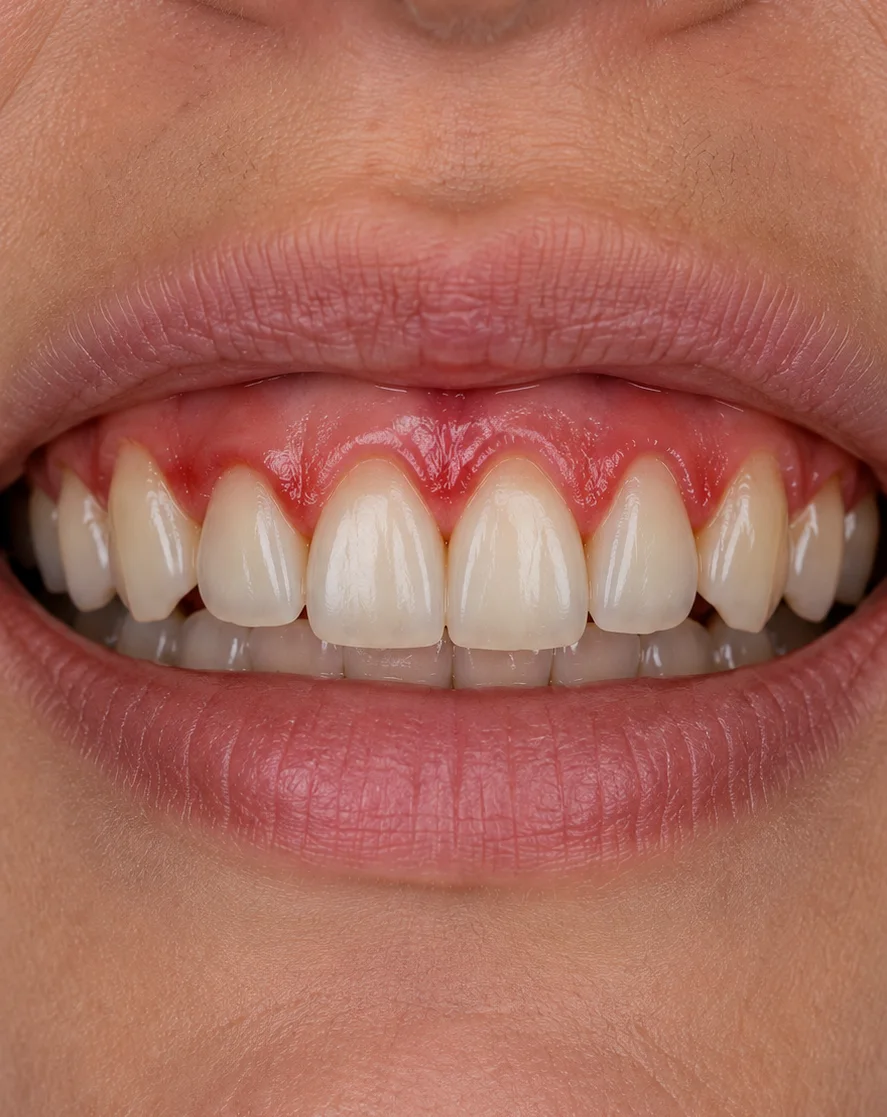
How do you notice peri-implantitis?
An implant has no nerve, so peri-implantitis can progress for a long time without pain. The first change most patients notice is bleeding around the implant when they brush.
Have the implant checked if you notice any of the following:
- Bleeding around the implant when brushing or flossing
- Redness or swelling of the gum around the implant
- A bad taste in the mouth or pus coming from around the implant
- The gum pulling back so that the metal surface of the implant starts to show
- A feeling that the implant moves
Mild symptoms do not mean the inflammation is mild. Bone loss can only be seen on an X-ray.
Two stages: mucositis and peri-implantitis
The inflammation starts in the gum around the implant only. This stage is called peri-implant mucositis. The bone is not yet affected, and with the right treatment the inflammation can clear up completely.
When the inflammation reaches the bone, peri-implantitis begins. The bone holding the implant starts to break down, and lost bone does not grow back on its own. At this stage, the aim of treatment is to stop it getting worse.
So if you see bleeding around an implant, do not wait. Mucositis is the only stage that can be fully reversed.
What is checked at the examination?
- How deep the pocket around the implant is and whether it bleeds
- The bone level around the implant, on an X-ray
- Whether the implant is stable
- Whether the crown on the implant can be cleaned properly and whether any cement has been left at its edge
- Factors that raise the risk, such as smoking, diabetes and past gum disease
Treatment is planned around these findings. Not every patient needs the same treatment.
Treatment by stage
Mucositis: cleaning without surgery
Plaque and tartar around the implant are removed with special instruments that do not scratch the implant surface. Standard ultrasonic tips are not used because they can damage the titanium surface. GBT, which first stains plaque so it can be seen and then removes it, may also be used at this stage. You will also plan together how to clean around the implant at home.
If bone loss has started: surgical treatment
Under local anaesthetic, the area around the implant is opened, the inflamed tissue is removed and the implant surface is cleaned of bacteria. Where suitable, a bone graft is placed where bone has been lost. The aim is not to rebuild all the lost bone but to stop the inflammation and keep the implant.
Advanced stage: removing the implant
If the implant moves, or if too much bone has been lost to support it, the implant is removed. Once the area has healed, the bone is assessed again. A bone graft is placed if needed and a new implant is planned.
Care after treatment
Peri-implantitis can come back after treatment. Regular care is how you keep the result:
- Clean around the implant every day with an interdental brush or a water flosser.
- Come in for professional cleaning and check-ups at the intervals your dentist sets.
- If you smoke, stopping lowers the risk of the inflammation coming back.
- If you have diabetes, keeping your blood sugar under control helps healing.
Who provides the treatment?
Diagnosing and treating peri-implantitis is part of periodontology, the specialty that deals with gum disease. At Papatya Dental, Elif Teke, Specialist Periodontist, works in this field. She qualified as a periodontology specialist in 2018 and works in the treatment of gum disease, gum surgery and soft and hard tissue procedures around implants.
The team also includes Assoc. Prof. Gülen Kamak, Specialist in Periodontology and Implantology.