
Most of the odour comes from the back of the tongue
The upper surface of the tongue is not smooth. Between the small projections called papillae lies a sheltered space where food debris, dead cells and bacteria collect. As those bacteria break down protein residues they release sulphur gases, and most of what is described as bad breath is made up of those gases. The thicker the coating grows, the stronger the odour becomes.
Brushing cleans the surfaces of the teeth and leaves the tongue untouched. That is why someone who brushes carefully can still wake up with a stale taste and a distinct odour: saliva flow drops during sleep, the tongue dries out and the coating thickens overnight. Drinking water dilutes the odour for a while but does not lift the coating.
You are the least likely person to notice your own breath, because the nose adapts to a constant smell within minutes. Smelling nothing does not mean the coating is not there.
Scraper or brush
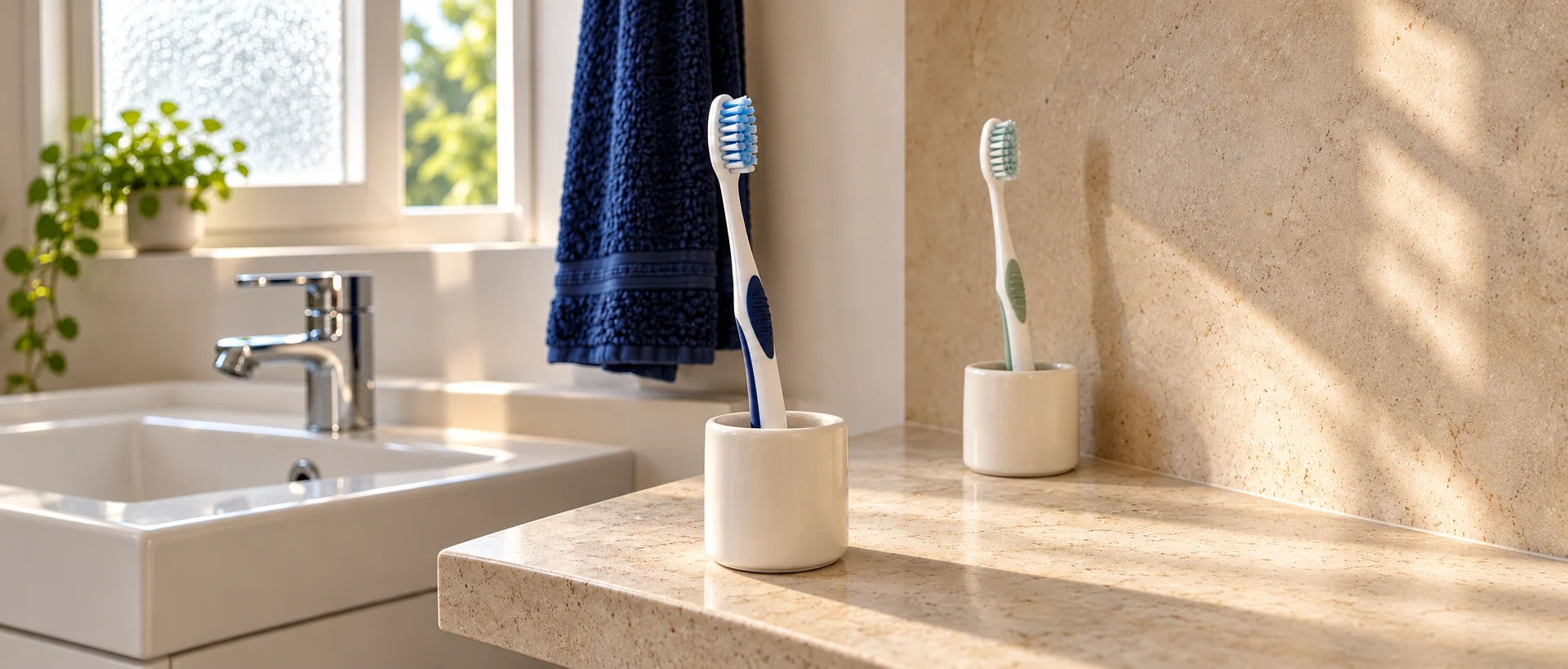
Both do the job. A scraper meets the surface as a wide strip and lifts more coating in a single pass; the ridged pad on the back of many toothbrushes is already in your hand. Bristles take some of it too, though they spread the coating sideways rather than reach between the papillae. For most people the choice comes down to the tool they will genuinely use every day.
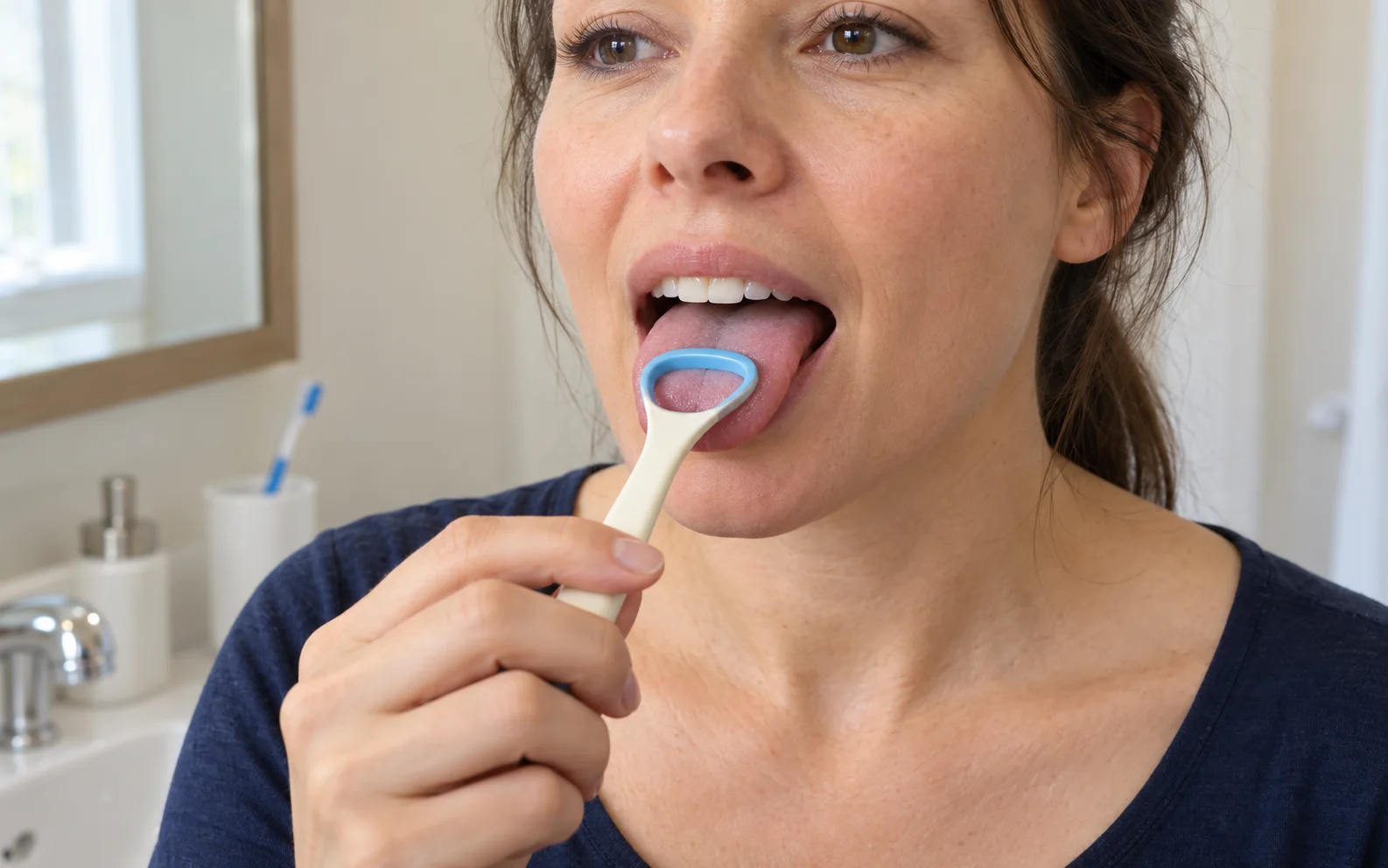
- Place the scraper well back, then draw it forwards in one direction; a back and forth motion only spreads the coating around.
- Rinse the tool under running water after each pass, then start the next strip.
- Three or four passes are enough for most people; stop when the surface looks pink again.
- If you are using the ridged pad on the back of a brush, keep the same direction and the same light pressure.
How far back to go
The part that contributes most to odour is the back third of the tongue; the front stays cleaner on its own, because it rubs against the palate while you speak and swallow. Even so, there is no need to reach the very back on day one. Starting in the middle and moving back about a finger's width every few days settles the gag reflex gradually. Pressure is not needed either: the coating is soft and comes away with a light touch.
Settling the gag reflex
- Breathe in through your nose and keep breathing while you scrape; holding your breath makes the reflex stronger.
- Push your tongue out as far as it will go, so the back of it moves forward and the tool stays away from your throat.
- Do it on an empty stomach, ideally before breakfast; a full stomach triggers the reflex more easily.
- If the reflex starts, stop for a few seconds, then carry on a millimetre further forward.
A white coating is not always thrush
Most pale coating on the tongue is ordinary debris: a dry mouth, smoking, a largely soft diet, mouth breathing when the nose is blocked and some medicines all make it thicker. That kind of coating thins out within a few days of regular cleaning. Oral thrush behaves differently: wiping the coating away leaves a red, tender surface underneath, and cleaning alone does not clear it. It turns up more often in denture wearers, in people with a dry mouth and in anyone whose immune system is weakened.
When the odour stays after all this
If tongue cleaning has become routine and the odour is still there, the source lies somewhere else. Gum inflammation, decay between the teeth, old fillings with open margins, medicines that reduce saliva, tonsil stones, nose and sinus trouble and reflux from the stomach become the likelier culprits. None of them responds to a tongue scraper; an examination, and an x-ray where needed, shows which one applies.
Frequently asked questions
How often should the tongue be cleaned?
Once a day suits most people, and the easiest moment is straight after the morning brush. Anyone whose coating builds up quickly can repeat it in the evening. More than twice a day tends to irritate the surface without adding anything.
How should a tongue scraper be cleaned, and when should it be replaced?
Rinse it well under running water after each use and store it somewhere dry and open; bacteria multiply in a closed, damp container. Replace a plastic scraper once its edge becomes rough, scratched or bent; a stainless steel one can last a long time unless it is damaged. If you use the ridged pad on the back of your toothbrush, it is replaced along with the brush, usually every three months or sooner if the bristles are worn.
Does scraping the tongue affect taste?
Done with light pressure it does no harm to the taste buds; if anything, flavours come through more clearly once the coating thins. Scraping hard irritates the surface and can leave a burning feeling or a dulled sense of taste for a few days. If you see bleeding, ease off.
Is a geographic or hairy tongue cleaned the same way?
A geographic tongue has smooth red patches that look like a map and change position over time; it is harmless and scraping does not change it. Carrying on with light passes, without pressing on those areas, is enough. In a hairy tongue the papillae grow longer and the surface looks dark and velvety; gentle, regular cleaning usually thins it within a few weeks. If the appearance of either changes, or burning or pain starts, show it to your dentist.
Should children clean their tongues too?
Once the teeth are through, a few gentle passes over the front of the tongue at the end of brushing are enough. The gag reflex is strong in small children, so the back of the tongue is left alone. A child who can hold the brush alone can learn this step alone as well.
Can mouthwash replace tongue cleaning?
A rinse lowers the number of bacteria on the surface for a while and masks the odour, but it does not lift the coating from between the papillae. Without mechanical cleaning the smell returns within a few hours. It works as an extra step, not as a substitute.
This content is for general information only and does not replace an examination.
Edited by
Nilufar Tulanova Şener
Medically reviewed by: Elif Teke, Specialist Periodontist
This article draws on the clinical experience of the Papatya Dental team and is reviewed for accuracy before publication.
- Last updated:
- 2026-09-21
- Editorial contact:
- icerik@papatyadental.com