
What changes when a brush stays wet
After brushing, water and bacteria from your mouth sit between the bristles. Left in the open, the bristles dry within a few hours, and the number of bacteria falls as they do. Shut the same brush away while it is still wet and the picture reverses: the moisture stays put, the base of the bristles stays damp for a long time, and the head turns into a comfortable spot for microorganisms. Every morning a slightly more crowded brush goes back into your mouth.
Upright, with the bristles in the air
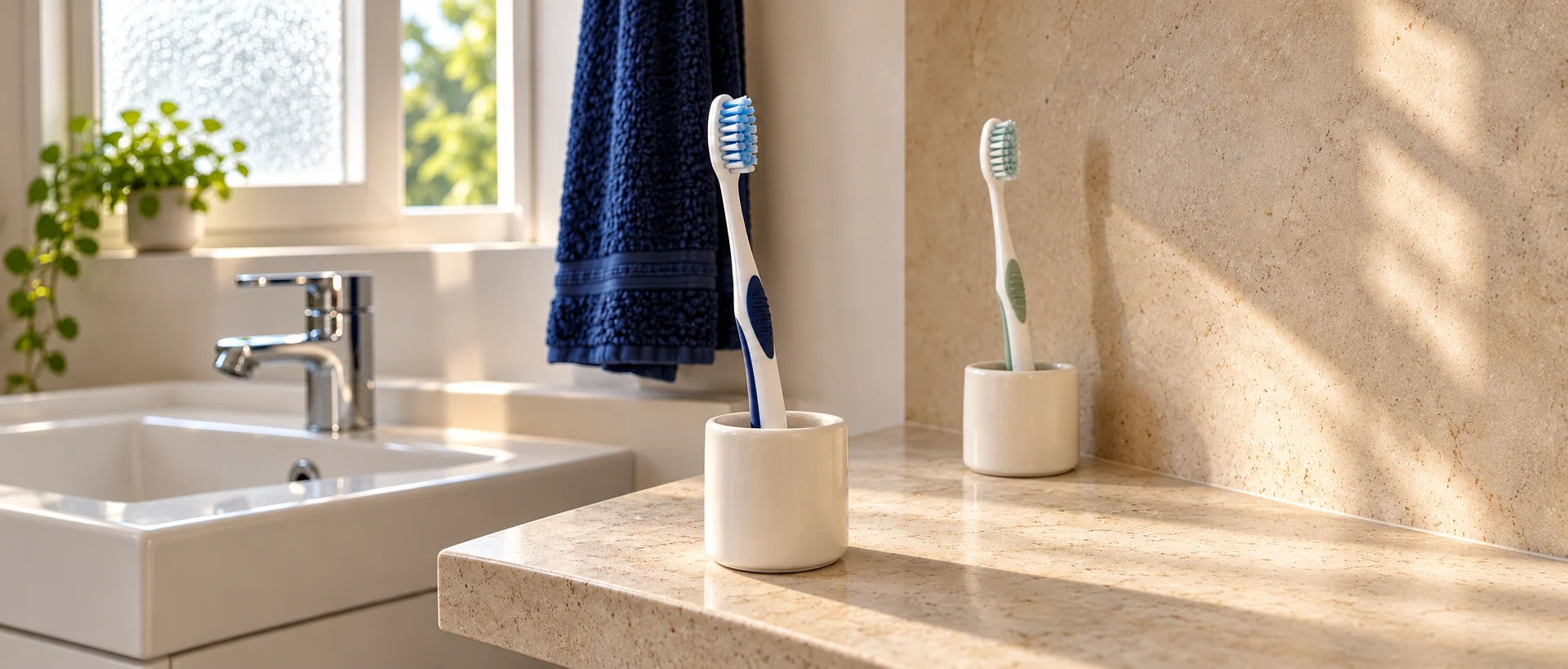
The simplest way of storing a brush is usually the one that works: stand it handle down in a beaker or holder so the bristles point up. Water then runs towards the handle instead of collecting between the bristles. A brush left lying flat stays wet underneath, and one resting on the edge of the basin also catches whatever splashes there. Do not forget the water pooling at the bottom of the beaker either; the holder needs a rinse and a wipe now and then.
- Rinse the bristles under running water after brushing so that no toothpaste or debris is left behind.
- Shake the brush a few times to throw off the excess water.
- Stand it handle down, bristles pointing up and open to the air.
- Do not dry between the bristles with a towel or tissue; it bends them and leaves lint behind.
Where the brush sits in the bathroom
Flushing sends a fine spray up into the air, and it settles on nearby surfaces. There is no established evidence that this makes people ill, but there is no reason to keep a toothbrush right beside the toilet either. Moving the brush to the far corner of the basin and closing the lid before you flush is enough.
Brushes that share a beaker
When every brush in the house ends up in one beaker, the heads touch and a wet one soaks its neighbour. The bacteria in a mouth belong to that mouth, and some of them, including the ones involved in decay, can travel this way from one person to another. Keep the brushes apart so that a gap remains between the heads, and use separate beakers if you have no holder. Two people sharing a single brush is not a good idea under any circumstances.
When a travel case earns its place
Caps and cases made for travelling protect a brush inside a bag, but they also cut off its air. Closing a wet brush into one and dropping it in the suitcase recreates exactly the conditions bacteria like. Dry the brush before you set off if you can; if you cannot, open the cap the moment you arrive and stand the brush up. Vented caps let some air through, but they will not dry a soaking brush.
Most of the bacteria on your brush came out of your own mouth. The trouble is not that they are there; it is that a damp brush lets them multiply overnight.
Sprays, tablets and ultraviolet cases
Sprays, dissolving tablets and small cases with an ultraviolet lamp are sold on the promise of ridding a brush of germs. They can lower the number of microorganisms on the head, but that this makes a measurable difference to oral health is not established knowledge. In a healthy person, a brush that has been rinsed and left to air-dry is considered enough. Putting a brush through the dishwasher or the microwave does harm instead: the heat distorts the bristles and the brush cleans less well afterwards.
Frequently asked questions
How long does a wet toothbrush take to dry?
Standing upright in the open, a wet brush is usually dry within a few hours; in a closed, airless corner it takes far longer. For someone brushing twice a day, the gap between morning and evening is normally plenty. If the bathroom is very humid, a shelf near a window or an extractor vent helps.
Should the brush be scalded with boiling water?
There is no need, and it does harm. Boiling water and microwaves soften the nylon bristles and bend them for good; bent bristles no longer reach the gum line or the spaces between the teeth, so the brush cleans less well. A brush that heat has pushed out of shape should be replaced, just like one with splayed bristles.
How should an electric brush head be stored?
Take the head off the handle after brushing and rinse the two parts separately, because toothpaste and water collect where they meet. Put the head back on, stand the handle upright with the bristles facing up, and keep the charging base dry.
Is a new brush needed after an illness?
Established advice is that an ordinary cold does not call for a new brush: meeting your own germs again does not start a fresh illness. What does call for a replacement is splayed bristles, or a brush that has been in use for three to four months.
Is a drawer a sensible place for a toothbrush?
A drawer is closed and airless; a wet brush dries slowly in there and touches dust and everything else stored alongside it. Keep the brush out in the open, upright and where air moves. If the look of it bothers you, a wall-mounted holder is tidier than a shelf and still leaves the bristles exposed.
This content is for general information only and does not replace an examination.
Edited by
Nilufar Tulanova Şener
Medically reviewed by: Canan Kale, Specialist in Paediatric Dentistry
This article draws on the clinical experience of the Papatya Dental team and is reviewed for accuracy before publication.
- Last updated:
- 2026-09-21
- Editorial contact:
- icerik@papatyadental.com