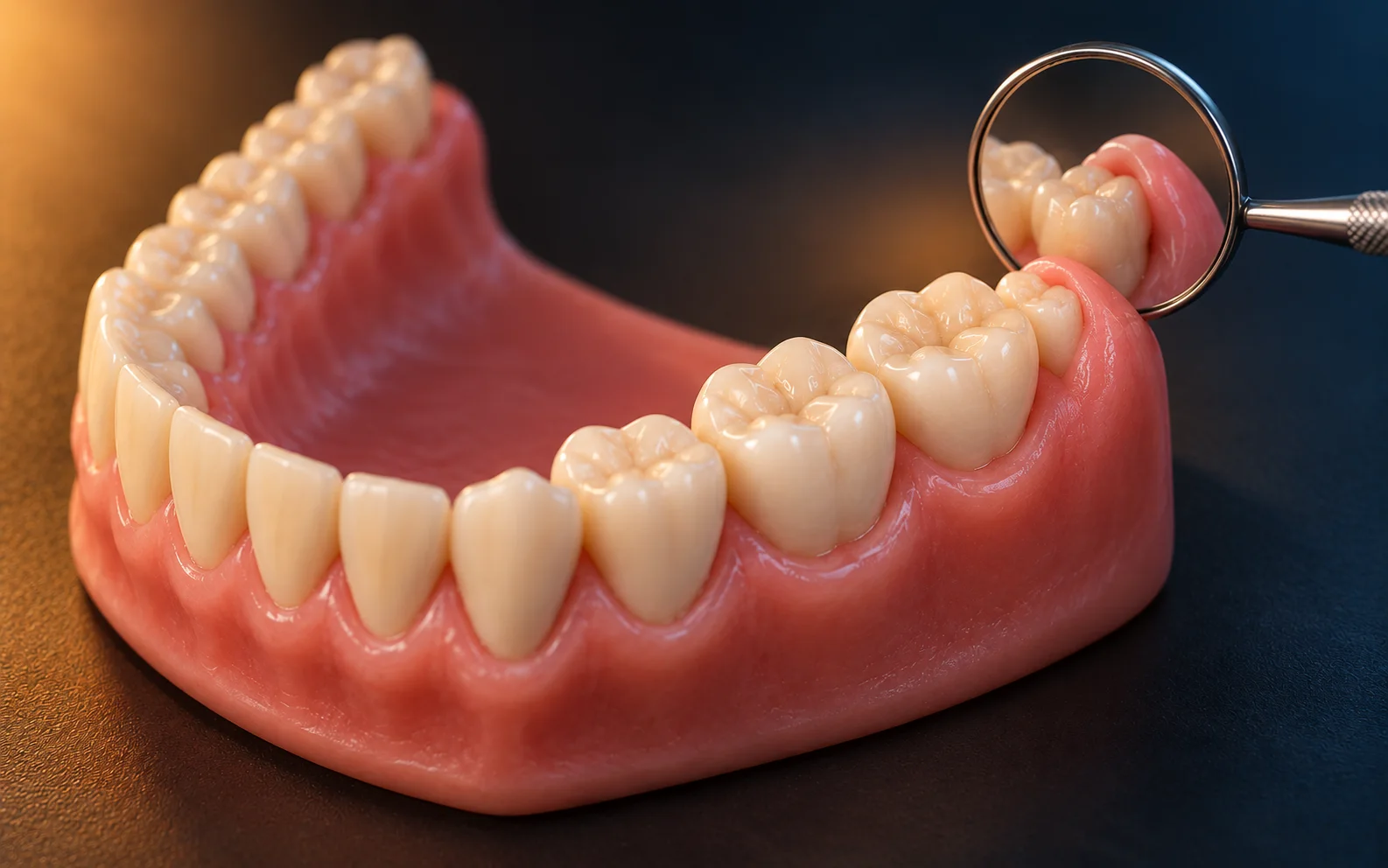

What these medicines do to bone
Bone is never finished. Old tissue is broken down and new tissue is laid down in its place, all the time. In osteoporosis the breaking down outpaces the rebuilding and the skeleton grows thinner. Bisphosphonates and denosumab slow the breaking down, so more bone stays where it is and fractures of the hip and spine become less frequent. The same substances are used in cancer care, but at far higher doses, given by drip or injection. Most of what is written about the jaw comes from that setting.
Why the jaw is treated separately
Only a thin layer of gum separates the jaw bone from the bacteria in the mouth. Once a tooth has been taken out, bone lies open for a while, and the socket closes only if the bone renews itself. When renewal is slowed, healing slows with it. Rarely the socket does not close at all: a small patch of bone stays exposed and becomes infected. Dentists call this osteonecrosis of the jaw.
The hip and spine fractures these medicines prevent are common, and their consequences are serious, while the jaw problem is rare. Weighing the two against each other is the job of the doctor who prescribes.
How large the risk really is
In someone treated for osteoporosis, osteonecrosis of the jaw is very uncommon; the great majority never develop it. The picture changes for cancer patients, who receive far higher doses. Putting a single number on it would mislead, because the risk shifts with which medicine it is, how it is given, how long it has been taken and what other conditions a person lives with. In osteoporosis, the decision to carry on is usually made with the fracture risk in mind.
- High doses given by drip or injection, as in cancer care
- Years of uninterrupted use
- Procedures that reach bone: tooth removal, implants, gum surgery
- Untreated gum disease or infected tooth roots
- Steroid tablets, poorly controlled diabetes, smoking
- A denture that rubs the gum and leaves sores
A dental check before the first dose
The simplest time is before treatment starts. Decay is filled, tartar is cleaned off, diseased gum is treated. Teeth that cannot be saved are taken out then, leaving enough time for the sockets to close before the first dose. If you wear a denture, it is checked for spots that rub. None of this becomes impossible once the medicine has started; the planning simply takes more care.
Dental treatment while you are taking it
It carries on. Fillings, root canal treatment, crowns, scaling and routine check-ups go ahead as normal, because none of them open bone. The procedures that need more thought are the ones that do reach bone: tooth removal, implants and gum surgery. When one of those is needed, the dentist speaks to the doctor who prescribed the medicine, and which medicine it is, the length of use and your other conditions are looked at together. Sometimes a tooth that would have come out is saved instead. Mention the medicine at every visit.
Do not stop the medicine on your own
Stopping because dental work is due brings the fracture risk back, and it does not lower the risk in the jaw quickly either. Some substances stay bound in bone for a long time and go on working after the last dose. Whether to pause is decided by the prescribing doctor alone, after a word with the dentist. One more thing: even if you stopped years ago, say so at a dental practice you are new to, because it may not show up in the notes.
Frequently asked questions
Can a tooth be taken out while I am on these medicines?
In most people it can, and the preparation is what decides the outcome. The dentist needs to know which medicine you take, how long you have taken it and what else you live with, and will speak to the prescribing doctor where that is useful. Infection in the mouth is settled beforehand, and the socket is watched closely afterwards.
Can I still have a dental implant?
For most people treated for osteoporosis an implant can be considered, though the answer is worked out case by case. Length of use, other conditions and how clean the mouth is kept all count. In cancer patients on far higher doses, implants are usually avoided.
Do I need a break from the medicine for dental work?
That is not a call the dentist can make alone, and not one for you either. In some situations the prescribing doctor considers a short pause; in most, none is thought necessary. Because stopping brings the fracture risk back, the two clinicians decide it together.
Does the risk disappear once I stop taking it?
Not straight away, and how long it lasts depends on the group. Bisphosphonates bind to bone and can stay there for years, while the effect of denosumab fades within a few months of the last dose. That is why your dentist needs to know which medicine you took in the past and when you had the last dose.
Does oral care really change the risk?
Indirectly, yes. The less decay and gum disease there is, the fewer teeth end up needing removal, and the less often bone is touched, the smaller the risk. Brushing twice a day, cleaning between the teeth and turning up for check-ups matter for that reason.
This content is for general information only and does not replace an examination.
Edited by
Ozan Ergen
Medically reviewed by: Ali Bulut, Specialist Oral, Dental and Maxillofacial Surgeon
This article draws on the clinical experience of the Papatya Dental team and is reviewed for accuracy before publication.
- Last updated:
- 2026-09-21
- Editorial contact:
- icerik@papatyadental.com