

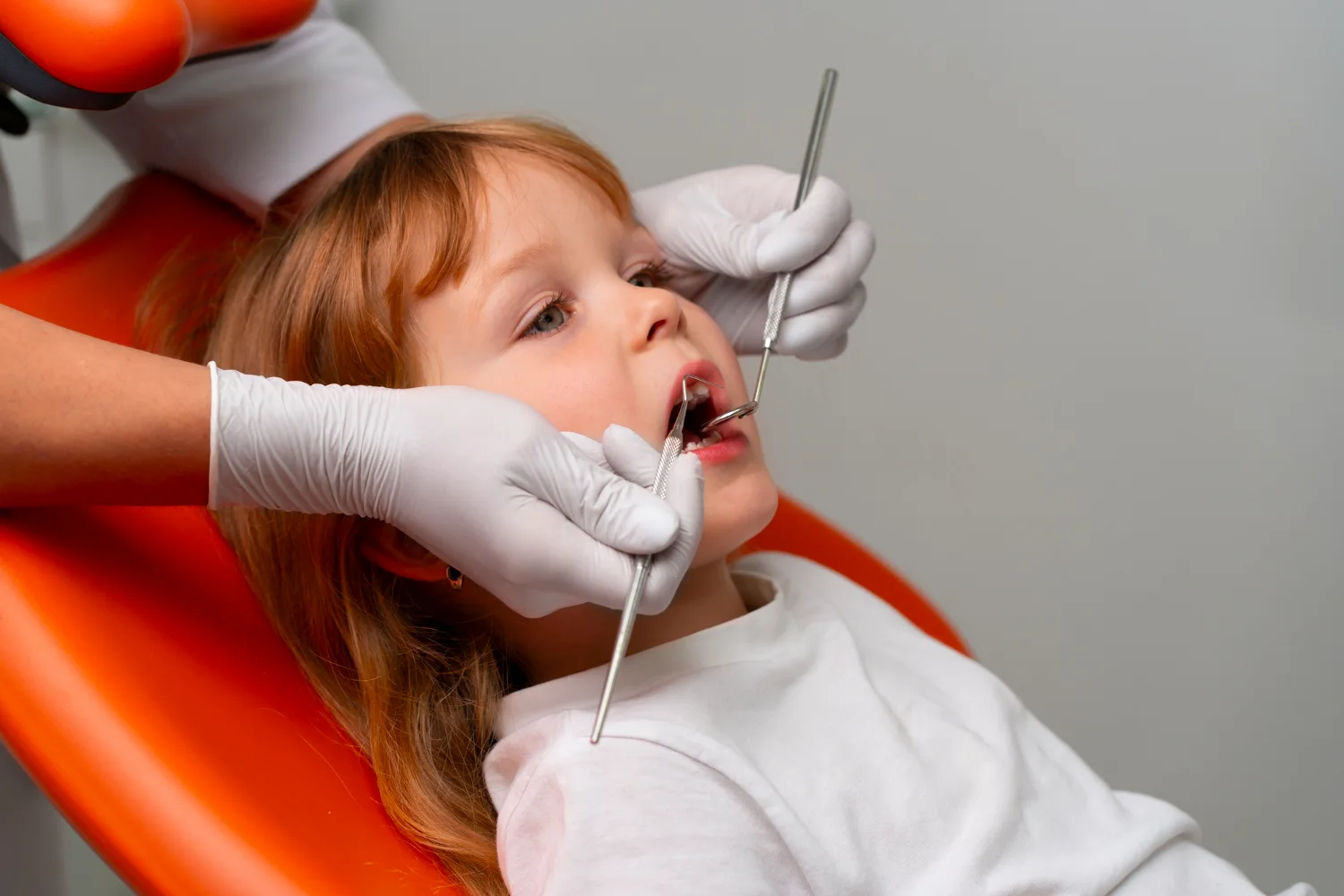
What Is Baby Tooth Root Canal Treatment?
Inside the tooth is a space containing blood vessels and nerve tissue, protected by hard tissues. When decay passes through the enamel and dentine and reaches this tissue, inflammation begins. Pain, severe sensitivity to hot or cold, or throbbing that wakes your child at night are symptoms of this stage. At this point, a filling is not enough because the problem is no longer on the surface of the tooth but inside it.
During root canal treatment, the affected tissue is removed, the space is filled with a suitable material, and the tooth is covered with a filling or crown. How much tissue is removed depends on how far the inflammation has spread: tissue may be removed only from the crown area, known as a pulpotomy, or all the tissue in the root canals may be removed, known as a pulpectomy. The appropriate option is determined through an examination and X-rays.
The most important difference between treatment of a baby tooth and treatment in an adult is the material used. The root of a baby tooth naturally dissolves as the permanent tooth underneath comes through. The material placed in the root canal must therefore also dissolve over time. Materials used in adults that do not dissolve can block the permanent tooth from coming through if used in a baby tooth. Treatment is planned differently for this reason and is usually shorter.
After treatment, the tooth often needs to be covered with a crown. A tooth whose internal tissue has been removed becomes more fragile. Especially in back molars, a stainless steel crown that surrounds the whole tooth is preferred so it can withstand chewing forces. This crown remains in place until the tooth is naturally lost and comes out with it. It is helpful to know that this stage is also taken into account when planning the appointments.
Who Is It Suitable For?
Whether root canal treatment is suitable is determined by assessing several factors together: how far the inflammation has progressed through the tooth, how much of the root has dissolved, how much healthy tooth tissue remains, and how well your child is likely to cope with the procedure. X-rays are essential for this decision because the condition around the root and the position of the developing permanent tooth underneath cannot be seen from the surface.
When decay has reached the nerve but the inflammation is limited. If the tissue is still viable and the inflammation is confined to the crown of the tooth, only that section can be removed and the tooth preserved. This is the situation in which the tooth is preserved as much as possible.
When the tooth is causing pain but can still be saved. If there is throbbing that wakes your child at night or severe sensitivity to hot or cold, and enough healthy tooth tissue remains, root canal treatment is considered instead of extraction.
When there is still time before the tooth is naturally lost. Back baby molars remain in the mouth until around ten to twelve years of age. Saving a tooth that would otherwise remain for several more years is clearly better than leaving its space empty.
When most of the root has not yet dissolved. If X-rays show that enough of the root structure remains, the material placed in the root canal will fit properly and treatment is more likely to progress predictably.
When the tooth has fractured following an injury. Root canal treatment is also considered when a fall or blow exposes the internal tissue of the tooth. In this situation, timing matters and treatment should not be delayed.
Why Papatya Dental?
Baby tooth root canal treatment is not simply a scaled-down version of adult treatment
At Papatya Dental, baby tooth root canal treatments are planned and carried out by our dentist who specialises in paediatric dentistry. The root of a baby tooth naturally dissolves as the permanent tooth comes through, so the material placed in the root canal must also be able to dissolve. Treatment carried out using an adult protocol can block the permanent tooth from coming through. The material and method are selected according to this principle, with each tooth assessed individually.
The decision to extract is not made on its own
If a baby tooth needs to be extracted, what will happen to the resulting space is part of the same plan. The need for a space maintainer is assessed together with the extraction decision, not afterwards. This helps prevent neighbouring teeth from moving and the space for the permanent tooth from becoming narrower.
The plan may change during the appointment, and we prepare for this
The true extent of the inflammation sometimes becomes clear only after the tissue has been opened. A procedure planned for the crown area alone may need to include the root canals as well. We explain this possibility to the parent before treatment begins and plan the appointment accordingly, so the family is not faced with an unexpected decision.
The experience in the chair is part of the treatment
A treatment that requires local anaesthetic and involves several stages can be a defining experience for many children. We explain what will happen in age-appropriate language. If your child is unable to cooperate, we divide the appointment or move it to another day. A child's first relationship with dentistry can affect their cooperation with treatment for the next twenty years.
A multidisciplinary team under one roof
Our dentists specialising in paediatric dentistry, periodontology, oral and maxillofacial surgery, and cosmetic dentistry all work in the same clinic. If the examination reveals a finding requiring assessment of jaw development, gum health, or surgery, the referral is made within the clinic, so the family is not sent to another organisation.
Follow-up across borders in seven languages
For families living in Antalya and those travelling from abroad, we manage the process in seven languages. Families returning to their home country receive records showing which tooth was treated, which material was used, and the X-ray findings, allowing follow-up to continue without interruption with another dentist.