

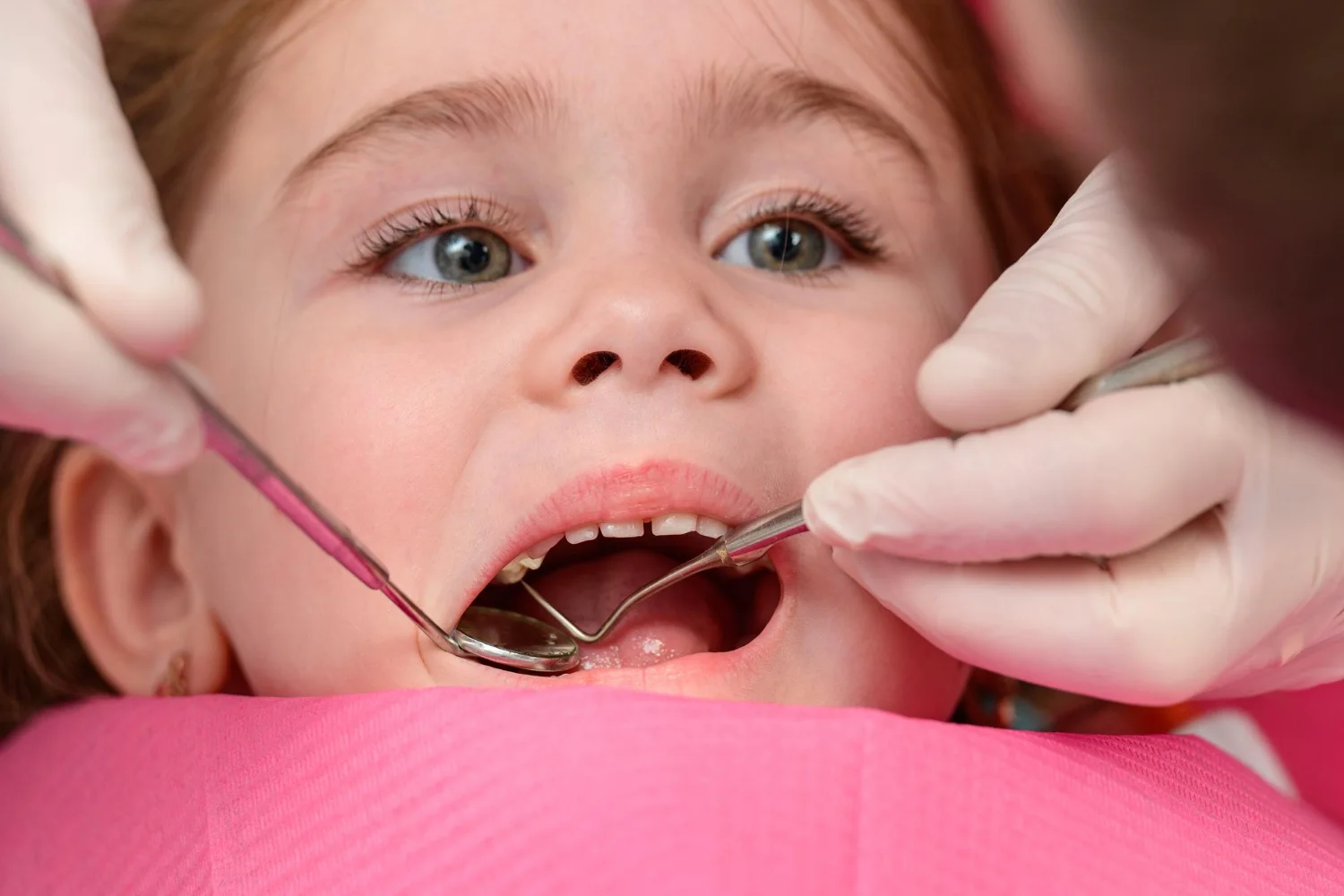
What Is a Baby Tooth Filling?
The fact that baby teeth are temporary does not mean decay is unimportant. The front baby teeth usually fall out around age six to seven, but the back baby molars remain in the mouth until around age ten to twelve. A four-year-old’s back baby molar still has another six to seven years to go, during which the child will eat and speak with that tooth.
The enamel and dentin layers of a baby tooth are thinner than those of a permanent tooth. As a result, decay progresses more quickly and reaches the nerve sooner. A process that takes months in a permanent tooth can progress over weeks in a baby tooth. A cavity that looks small can quickly become painful.
The effects of untreated decay are not limited to the tooth itself. An infection can progress from the tooth’s root and affect the permanent tooth developing underneath. When that permanent tooth erupts, changes in its colour or structure may be visible. If a baby tooth is lost early, neighbouring teeth can shift into the space, reducing the room available for the permanent tooth to erupt and potentially making orthodontic treatment necessary later.
The purpose of a filling is to remove the decay and seal the tooth, prevent pain, and keep the tooth functioning until it is time for it to fall out. Different methods are used depending on how deep the decay is. In some cases, a filling is not enough and the tooth may need to be covered with a crown. The appropriate approach is determined during the examination.
Who Is It Suitable For?
Whether a filling is appropriate is determined by assessing the depth of the decay, how much healthy tooth structure remains, how long the tooth is expected to stay in the mouth, and how well your child can cooperate with the procedure. If the decay is limited to the enamel and dentin, and has not reached the tooth’s nerve, it can usually be cleaned and sealed with a filling. This is the most common situation and the one in which the tooth can be preserved most effectively.
If the tooth is expected to remain in the mouth for a long time. For teeth such as the back baby molars, which have several years before they fall out, a filling is preferred to keep the tooth functioning during that period.
If the tooth has sufficient healthy walls. A filling is suitable when enough healthy tooth structure remains after the decay is removed for the filling to bond to.
If your child reports pain or sensitivity. Sensitivity while eating, pain with sweet foods, or avoiding chewing on one side should be assessed. In many cases, these symptoms are caused by decay that can be treated with a filling.
If there is visible damage. If you notice discolouration, a depression in the surface, or a fracture, the tooth should be examined. Decay can progress even without causing pain. The depth of the decay and the condition of the tooth. The dentist checks how far the decay has progressed, whether it is close to the nerve, and how many surfaces of the tooth are affected. If necessary, an X-ray is taken, as decay between the teeth and the condition around the roots cannot be seen from the surface.
Your child’s cooperation and general health. How well your child can tolerate the length of the procedure, previous dental experiences, and any general health conditions are assessed together. This affects which method is chosen and how many appointments are planned. If the decay has reached the nerve. A filling alone is not sufficient if the nerve tissue is affected. Root canal treatment or a crown may be needed. If the infection has progressed, extraction may be considered.
If most of the tooth has been lost. If there is not enough healthy tooth structure for a filling to bond to, the filling may fracture soon afterwards. In this situation, a crown that covers the entire tooth is generally more suitable.
If the tooth is due to fall out very soon. If the tooth is loose and is likely to fall out shortly, monitoring it may be preferred over placing a filling. The dentist makes this decision together with the X-ray findings.
Why Papatya Dental Clinic?
A filling for a child is not simply a smaller version of an adult filling
At Papatya Dental, baby tooth treatments are planned and carried out by our dentist who specialises in paediatric dentistry. Because the enamel structure of baby teeth, the rate at which decay progresses, and the time remaining before the tooth falls out differ from permanent teeth, materials and techniques are selected according to different criteria. The most appropriate approach is assessed individually for each tooth.
The treatment plan may change during the appointment, and we are prepared for that
The true depth of the decay sometimes becomes clear only during cleaning. A procedure planned as a filling may need to be changed to root canal treatment or a crown. We explain this possibility to the parent before starting and plan the appointment accordingly, so families are not faced with an unexpected decision.
The experience in the dental chair is part of the treatment
The first procedure requiring local anaesthetic is a significant moment for most children. We explain what will happen in age-appropriate language. If a child is unable to cooperate, we divide the appointment into shorter stages or reschedule it for another day. A child’s first relationship with dentistry can affect their willingness to undergo treatment over the next twenty years.
A multidisciplinary team under one roof
Our specialists in paediatric dentistry, periodontology, oral and maxillofacial surgery, and aesthetic dentistry all work at the same clinic. If the examination reveals a finding requiring assessment of gum health, jaw development, or surgery, the referral is handled within the clinic, so families do not have to be sent to another institution.
Follow-up across borders in seven languages
We provide care in seven languages for families living in Antalya and those travelling from abroad. Families returning to their home country receive records showing which treatment was performed on which tooth, the material used, and the examination findings, allowing follow-up with another dentist to continue without interruption.