
Two tools, two different jobs
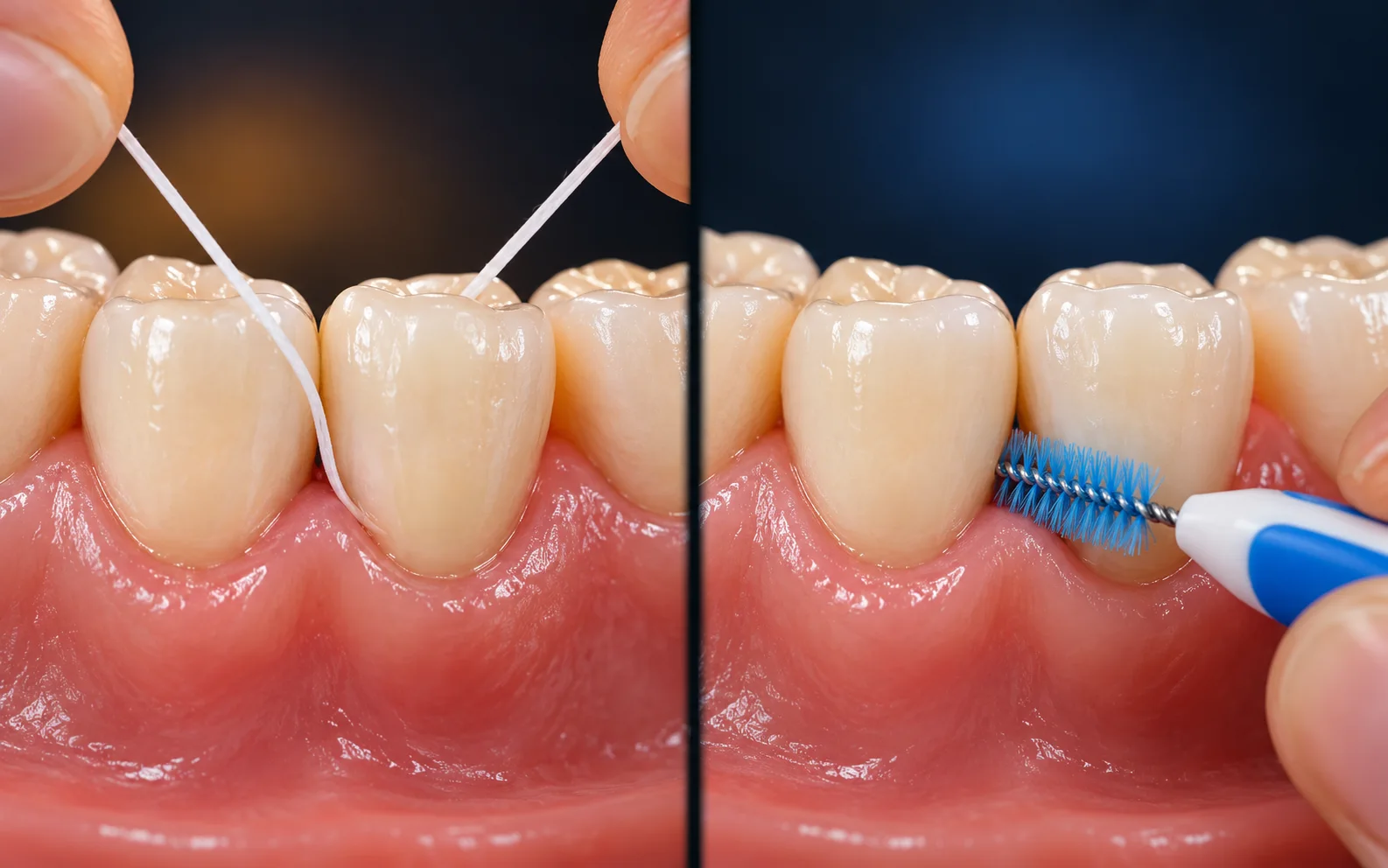
A toothbrush cleans the cheek side and the tongue side of a tooth; the bristles never reach the surface where two teeth touch. Floss and interdental brushes exist for exactly that unreached surface, but they work in different ways. Floss passes through the contact point like a thin ribbon and scrapes both surfaces. An interdental brush fills the space instead, so the bristles meet the surface from every direction. That difference decides which one will help in your mouth.
Where there is space, the brush cleans more
If a visible triangle sits open between two teeth, floss runs down the middle of it and barely touches the sides. An interdental brush fills that same volume: the bristles wipe the surfaces on the left and on the right at the same time. The wider the gap, the more surface floss leaves untouched.
Tight contacts leave floss as the only option
Where teeth sit closely together and not even the thinnest brush will pass, the job falls to floss. Floss is thin enough for the contact point and goes down with a light spring rather than a push. Forcing a brush into a gap like that grazes the gum, bends the wire and usually leaves half the bristles outside. In a young mouth with firm gums, most gaps are this tight, and nothing else takes the place of floss there.
Sizing is done without force
Interdental brushes are made in a range of thicknesses, and no mouth is uniform: the gaps between the front teeth are narrow, the ones between molars usually wider. The right size enters with slight friction but never needs pushing. If the wire bends, the brush is too thick; if it slides through without touching anything, it is too thin. Most mouths end up using two or three sizes.
- Angle the brush along the gap rather than straight at the gum.
- Once it is in, move it back and forth a few times without twisting it.
- If a gap resists, drop down one size instead of insisting.
- Replace a brush as soon as the wire is bent or the bristles have flattened.
Receding gums change the picture
When the gum recedes the root surface is exposed, and that surface is not flat: on many molars a groove runs the length of the root. Taut floss passes straight over that groove and cannot drop into it, while bristles can. Exposed root is softer than enamel and decay travels through it faster. That is why an interdental brush becomes the main daily tool in mouths where the gums have receded.
Decay and gum inflammation most often begin on the surfaces where two teeth meet, which are precisely the surfaces a toothbrush never reaches.
Bleeding is not a reason to stop
Bleeding during the first days of interdental cleaning is common and usually means the gum at that spot is inflamed. Healthy gum does not bleed when it is cleaned. Stopping because of the blood leaves the plaque that feeds the inflammation exactly where it is; with steady daily cleaning the bleeding settles in most people within two weeks. Bleeding that lasts longer, comes from the same single spot or keeps getting worse should be looked at by a dentist.
Bridges, implants and fixed braces
Neither plain floss nor an ordinary brush fits under the body of a bridge, along the margin of an implant crown, or between teeth carrying fixed braces. These sites call for special floss with a stiff tip and a spongy middle, or thin plastic threaders that carry the floss behind the wire. The smallest interdental brushes fit under the brackets. The dentist who fitted the bridge or the braces can show which tool reaches which spot.
Frequently asked questions
Do you need to use both?
In most mouths, yes. The gaps between the molars may be open while the front teeth still sit tightly together; the brush then works at the back and floss at the front. Matching the tool to each part of the mouth works better than sticking to one of them.
Can an interdental brush damage the gum?
Used properly, it does not. Injury usually comes from gripping the handle tightly and pressing the brush into the gap, or from twisting it inside; holding the handle lightly with your fingertips keeps the force down on its own. Slight bleeding in the first days is a sign of inflammation, not injury; a sharp pain or a cut means the brush is being forced.
How often should the gaps be cleaned?
Once a day is enough for most people, usually alongside the evening brushing. Plaque needs more than a day to build into a layer that irritates the gum, so cleaning once a day without missing days does more than cleaning twice a day now and then.
Does a water flosser replace floss?
A water jet flushes loose debris away and helps around fixed braces, but it does not rub off plaque that is stuck to the surface. It is generally seen as an addition to floss or an interdental brush rather than a substitute for either.
Does flossing open up the gaps?
No. As the floss passes the contact point the tooth flexes for a moment and springs back; the gap is not left any wider. Gaps that open over time usually come from receding gums or from teeth drifting out of place.
Waxed or unwaxed floss?
Waxed floss slips through tight contacts more easily and shreds less; unwaxed floss grips the surface a little more. Both lift plaque, so the choice usually comes down to which one passes without catching.
This content is for general information only and does not replace an examination.
Edited by
Canan Kale
Medically reviewed by: Elif Teke, Specialist Periodontist
This article draws on the clinical experience of the Papatya Dental team and is reviewed for accuracy before publication.
- Last updated:
- 2026-09-21
- Editorial contact:
- icerik@papatyadental.com