
What charcoal does and does not do
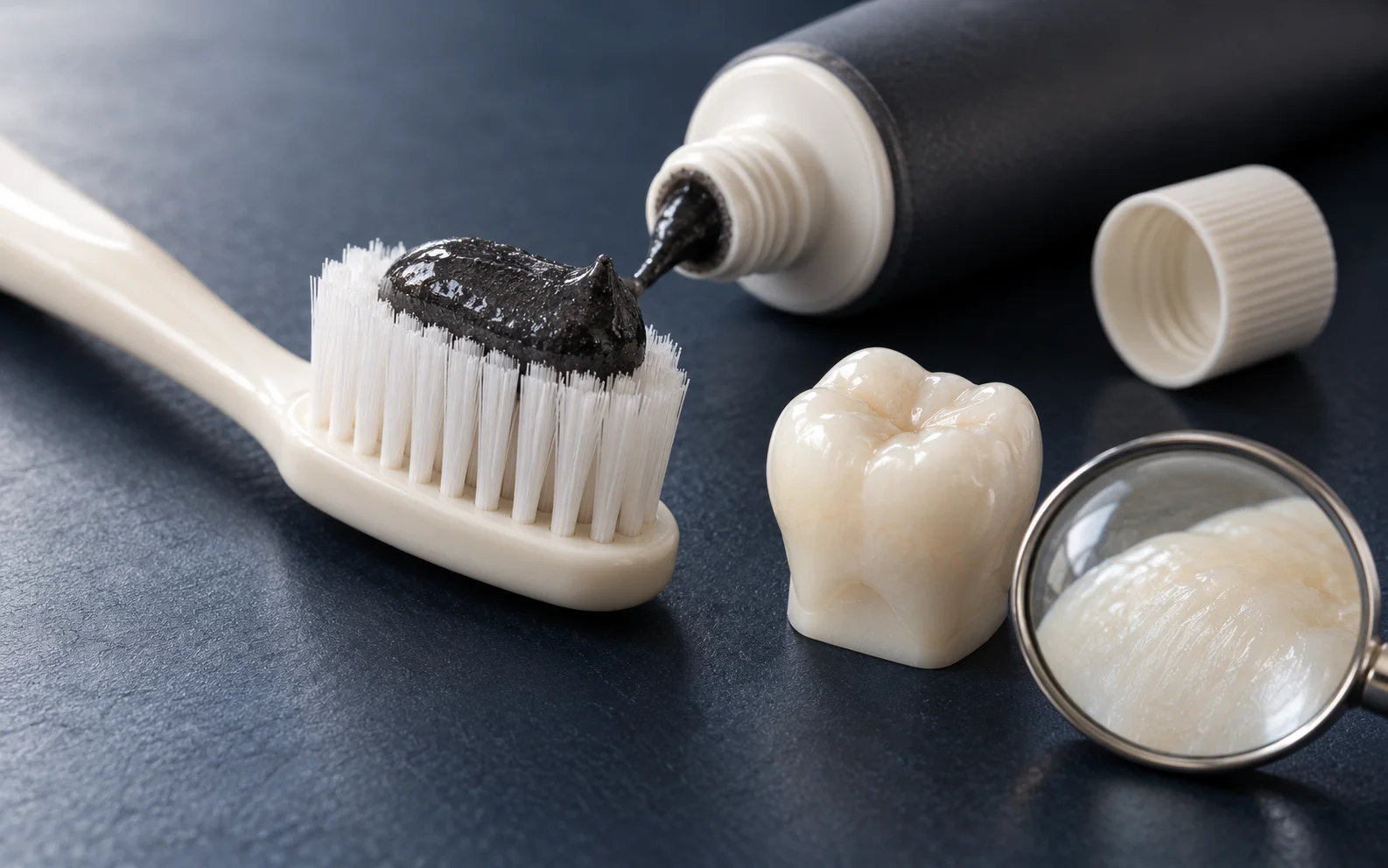
Charcoal toothpaste does not whiten a tooth. The charcoal particles work as an abrasive and grind off the coffee, tea and tobacco stain stuck to the outer surface; how harshly they do so varies from product to product. Once that film is gone the tooth can look a shade lighter. The colour of the tooth itself has not changed; there is simply less sitting on top of it.
Surface stain or the colour of the tooth
Teeth darken in two separate ways. One is staining on the outside, the other is the colour of the dentine underneath the enamel. Charcoal only reaches the first. When enamel thins with the years and the yellower layer beneath begins to show through, no abrasive paste reverses that.
- Outside staining: left behind by coffee, tea, red wine, tobacco and some mouthwashes, and it lifts with brushing.
- Inner discolouration: the natural shade of dentine, the way it thickens with age, darkening after a knock, or certain medicines taken in childhood.
- Charcoal only touches the first group; on the second it does nothing at all.
Abrasiveness: the figure that is not on the tube
Every toothpaste has a degree of abrasiveness, expressed as an RDA value. A paste with a low value lifts stain slowly; one with a high value lifts it quickly and takes more enamel with it. The snag with charcoal pastes is that the value is rarely printed on the box and varies a great deal from product to product. You cannot tell by looking whether the tube in your hand is gentle or harsh.
Enamel does not grow back
Enamel is the hardest tissue in the body, but it is not alive. A broken bone repairs itself; worn enamel does not. Early mineral loss can be made good to some degree by fluoride, while enamel that has been physically scraped away is gone for good. That is why the effect of an abrasive paste builds up across years.
A paste that lightens teeth quickly is not good news; that speed usually comes from a coarser abrasive.
Receding gums leave the root exposed
When the gum pulls back, the upper part of the root opens into the mouth. There is no enamel there, only a much softer tissue. A paste that struggles to wear down enamel cuts into root surface many times faster. The result is sharp sensitivity to cold and sweet things, and sometimes wedge-shaped notches at the neck of the tooth.
If your gums have receded, if a yellowish band shows at the necks of your teeth, or if a cold drink brings a short sharp pain, an abrasive paste makes exactly that worse. In that situation it is better to stop using abrasive pastes, but finding out why the gum receded matters more than which tube you pick up.
Most charcoal pastes contain no fluoride
A large share of charcoal products are made without fluoride. Fluoride is the ingredient that helps enamel remineralise and holds decay in check; in a daily paste that is the main job. A paste without it still cleans mechanically, but it gives no protection against decay. Chasing a lighter shade can leave you with more cavities instead.
- Check the box for fluoride; without it, a paste is not suited to daily use.
- If the label talks about polishing or stain removal, that paste was never designed for every day.
- Look in the ingredients list for a fluoride compound such as sodium fluoride, sodium monofluorophosphate or stannous fluoride.
If the staining really bothers you
A clean at the practice lifts stain without the daily grinding, and it reaches places a brush never gets to. The source can be tackled as well: rinsing with water after coffee or tea slows the staining down. If you use a charcoal paste, bear in mind that charcoal particles can lodge along the edges of fillings and crowns or in the groove at the gum line and leave a darker line there. And if a single tooth darkens on its own, that is not surface stain at all, so it needs showing to a dentist rather than scrubbing.
Frequently asked questions
Does charcoal toothpaste actually whiten teeth?
No. It does not change the colour of the tooth itself. What it does is grind stain off the surface, and with the stain gone the tooth looks slightly lighter. If the enamel has thinned and the dentine underneath is showing, charcoal cannot reverse that.
Is using it once a week harmful?
Occasional use wears far less than daily use. Even so, if there is gum recession, enamel wear or sensitivity, even occasional use is a poor idea. That judgement is better made together with a dentist who can actually see your mouth.
How is a whitening toothpaste different from a charcoal one?
Both mostly act on surface stain. Most pastes sold as whitening also lift stain, either with abrasives or with ingredients that loosen it; an important difference is that most of them contain fluoride. What lightens the colour of the tooth itself is peroxide whitening, which is best done under a dentist's supervision.
Can children use charcoal toothpaste?
It is not recommended. Enamel on baby teeth is thinner, and on newly erupted adult teeth it has not fully matured yet. At this age a fluoride toothpaste is the basis of protection against decay; ask your dentist which paste suits your child and how much to use.
Can charcoal toothpaste harm the gums?
Charcoal particles can collect along the gum margin, and with hard brushing that is where the gum is put under the most strain. If your gums bleed when you brush or a grey line appears at the margin, take a break from the charcoal paste and have your dentist look at it.
This content is for general information only and does not replace an examination.
Edited by
Samed Kağan Bozkurt
Medically reviewed by: Nilufar Tulanova Şener, Dentist, Aesthetic Dentistry
This article draws on the clinical experience of the Papatya Dental team and is reviewed for accuracy before publication.
- Last updated:
- 2026-09-21
- Editorial contact:
- icerik@papatyadental.com