

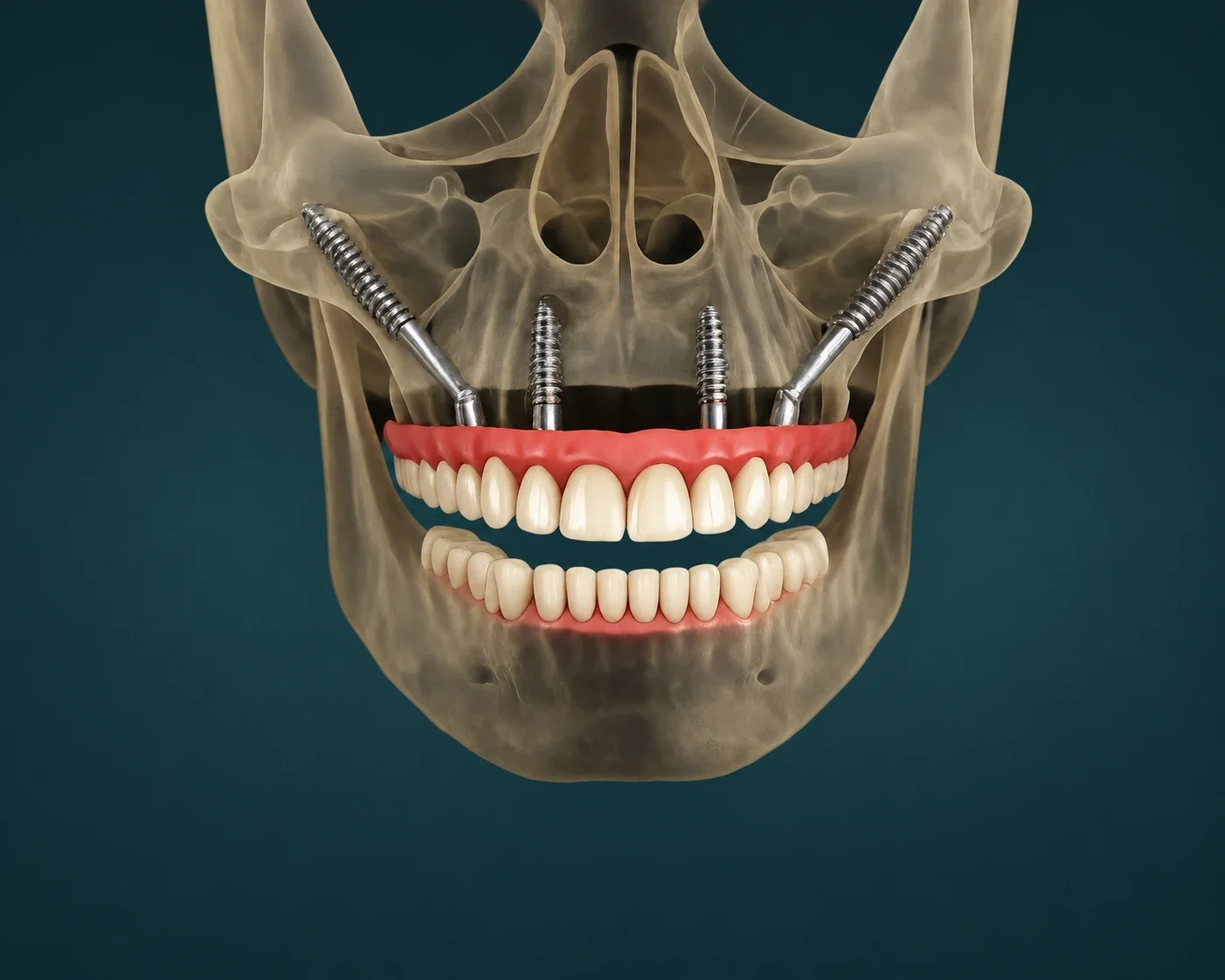
What Are Zygomatic Implants?
At Papatya Dental Clinic in Antalya, Turkey, zygomatic implants are planned on a 3D scan and placed by our oral and maxillofacial surgeons Ali Bulut and Ozan Ergen. Patients travel to us for zygomatic implants from the UK and across Europe, so this page also covers how the two stages of treatment fit around trips to Turkey and how aftercare works once you are home. The clinic holds the Ministry of Health's International Health Tourism Authorization Certificate and ISO 9001 certification, and patients rate it 4.7 out of 5 on Google.
Zygomatic implants are long implants placed so that they reach into the cheekbone (the zygoma) when there is not enough bone in the upper jaw. A standard implant is usually 8–13 mm long; zygomatic implants are 30–60 mm long. Even when the bone of the upper jaw has shrunk, the cheekbone usually stays firm and dense, and the implant takes its support from it. Zygomatic implants are used only in the upper jaw.
After teeth are lost, the bone of the upper jaw slowly shrinks. At the back of the mouth, the sinus expands downwards. Advanced gum disease and years of wearing a removable denture can add to the bone loss. Standard implants then often need a bone graft and a sinus lift first, which can stretch treatment over months, sometimes more than a year. Zygomatic implants can make fixed teeth possible without these extra operations.
The layout is planned from what the scan shows. In the classic approach, one zygomatic implant is placed on each side, with two to four standard implants at the front. If there is not enough bone at the front either, two zygomatic implants go on each side; this is called quad zygoma. When bone loss affects one side only, a one-sided approach is possible. Whatever the layout, the implants are finally joined together by a single fixed bridge.
Zygomatic implants have been used to treat severe bone loss in the upper jaw since the late 1990s. In the 2023 ITI consensus report, implant survival was 96.2% over an average follow-up of 6.3 years. A 2026 Cochrane review found that, compared with standard implants placed after bone grafting, zygomatic implants probably fail less often but probably lead to more complications. The most common problem is sinusitis.
Support
The implant is anchored in the cheekbone as well as in the bone of the upper jaw.
Where it is used
Only in the upper jaw, when there is not enough bone for standard implants.
Bone graft
Usually not needed, so treatment does not have to wait for a graft to heal.
Teeth after surgery
If the implants hold firmly enough, a fixed temporary bridge can be fitted without waiting for them to fuse with the bone.
Long-term results
Implant survival of 96.2% over an average of 6 years in a 2023 systematic review.
Who Might Zygomatic Implants Suit?
Zygomatic implants are considered when there is not enough bone in the upper jaw for standard implants. The decision is made by looking at your scan, your general health and what you expect from treatment together.
Severe bone loss in the upper jaw
If the height or width of the bone is not enough for standard implants and a large bone graft would be needed.
A bone graft that did not take
If an earlier bone graft failed, or you would rather avoid a long grafting process.
Lost implants in the upper jaw
If earlier implants were removed because of bone loss and too little bone is left for new ones.
An upper denture that will not stay in place
If your upper denture no longer holds because the bone has shrunk over the years, and you want fixed teeth.
Cheekbone and upper jaw
The scan measures the volume of the cheekbone, the bone left in the upper jaw and the path each implant will follow.
Sinus health
Any inflammation or blockage in the sinuses is treated first; an ear, nose and throat specialist may be asked for an opinion.
General health and medicines
Poorly controlled diabetes, some medicines used for osteoporosis and past radiotherapy to the head and neck can change the plan.
Smoking and oral hygiene
Smoking slows healing. Being able to clean under the bridge every day is also part of the treatment.
Untreated sinus infection
Surgery is postponed until active sinusitis has been treated.
Enough bone in the upper jaw
If there is enough bone for standard implants, zygomatic implants are not needed.
Limited mouth opening
Surgery needs the mouth to open wide enough, and your general health must allow a longer operation.
Possible Risks and Limits of Zygomatic Implants
Zygomatic implant surgery is more extensive than standard implant surgery and needs experience. The known risks are listed below; most can be reduced with careful planning and regular check-ups.
Sinusitis
This is the most common problem. A review that pooled long-term studies reported it in about 14% of patients over 5 years. It can be treated with medicines or ear, nose and throat surgery; rarely, the implant has to be removed.
Gum problems around the implant
Inflammation or recession of the gum can occur where the implant comes through into the mouth. Daily cleaning lowers this risk.
An opening between the mouth and the sinus
Rarely, an opening forms between the mouth and the sinus (an oroantral fistula) and needs to be closed.
Numbness
Temporary numbness of the cheek or upper lip can occur; it usually fades within weeks.
Implant loss
An implant may fail to fuse with the bone or be lost over the years. In the long-term review, the yearly failure rate was about 0.7%.
Problems with the bridge
A screw can loosen or the bridge can crack; these can usually be repaired.
Rare serious complications
Injury to nearby structures such as the eye socket has been reported very rarely. 3D planning aims to reduce this risk.
How Zygomatic Implant Treatment in Turkey Is Carried Out
Treatment is usually done in two stages a few months apart: first the surgery and a fixed temporary bridge, then the final bridge once the implants have fused with the bone. For patients travelling to Turkey, that means two visits to Antalya; how many days each stage takes is confirmed once your scan has been assessed.
Examination and 3D scan
Your dentist examines your mouth, any remaining teeth, your gums and your bite. A 3D dental scan (cone beam CT) shows the upper jaw, the cheekbones and the sinuses. Your medical history and the medicines you take are discussed.
Digital planning
The number, angle and path of the implants are planned on a computer. The layout and the design of the temporary bridge are decided at this stage.
Preparation
Teeth that cannot be saved are removed if needed, and any gum or sinus problems are treated first. The type of anaesthesia is chosen according to your health.
Surgery
Zygomatic implants are usually placed under general anaesthesia or deep sedation. Depending on the plan, standard implants are also placed at the front.
Fixed temporary bridge
If the implants hold firmly enough during surgery, a fixed temporary bridge is fitted within the first few days. This is called immediate loading. If they do not, the bridge is postponed and the implants are left to heal first.
Healing and fusion with the bone
It usually takes 4–6 months for the implants to fuse with the bone. During this time you eat soft foods with the temporary bridge and come for regular check-ups.
Final bridge
Once healing is complete, impressions or scans are taken and the final bridge is made. After a try-in and bite adjustment, it is screwed into place, so your dentist can remove it for check-ups and cleaning.
Alternatives to Zygomatic Implants
Depending on your bone and what you expect from treatment, these options can also be considered.
Standard implants after a bone graft and sinus lift
The bone is built up with a graft first, and the implants are placed once it has healed. Treatment takes longer; sinusitis has been reported less often with this approach.
A full-arch bridge on tilted implants (All-on-4 / All-on-6)
If there is enough bone at the front, the back implants can be tilted to avoid the sinus.
Pterygoid implants
These take their support from the hard bone at the very back of the upper jaw; in some plans they are used instead of, or alongside, zygomatic implants.
Short implants
If the bone height is only moderately reduced, short implants may be enough without a bone graft.
An implant-retained or conventional denture
A removable denture held by fewer implants, or with no implants at all, is another option.
How Zygomatic Implants Are Planned and Placed
Planning is based on a 3D dental scan. The scan measures the thickness of the cheekbone, the bone left in the upper jaw, the condition of the sinuses and the distance to nearby structures such as the eye socket. The angle and length of each implant are chosen from these measurements.
In the original technique, the implant passes through the sinus to reach the cheekbone. Today the path is chosen to suit the shape of your jaw: the implant can run close to the sinus wall or completely outside the sinus. In a 2024 meta-analysis, sinusitis was reported less often when the implant ran outside the sinus than with techniques that pass through it.
Because zygomatic implants are long and placed at an angle, they are never left on their own. Together with the implants at the front, they are joined by a rigid, one-piece bridge that runs along the jaw. This spreads chewing forces across all the implants.
3D dental scan
The cheekbones, upper jaw and sinuses are measured to plan the path of each implant.
Implant path planned for you
Whether the implant runs inside or outside the sinus depends on the shape of your jaw.
Immediate loading
In suitable cases, the implants carry a fixed temporary bridge before they have fused with the bone.
Screw-retained final bridge
The final bridge is screwed into place, so your dentist can remove it for check-ups and maintenance.
Recovery After Zygomatic Implants and Aftercare at Home
Recovery varies from person to person. Swelling and bruising are common in the first few days and usually settle within two weeks.
The first 2–3 days
You may have swelling and bruising on your cheeks and under your eyes, and some light bleeding from the nose. Cold packs, keeping your head raised and taking the medicines you were given regularly all help.
The first two weeks
The swelling goes down gradually. Do not blow your nose hard, sneeze with your mouth open and do not drink through a straw. Any stitches are removed during this time.
The first months
While the implants fuse with the bone, eat soft foods with the temporary bridge and avoid biting into hard or sticky food. You will have regular check-ups during this period.
Long term
After the final bridge is fitted, check-ups and professional cleaning are usually recommended every 6–12 months. The implants, gums and sinuses are assessed at each visit.
Cleaning under the bridge
Clean the side of the bridge that faces the gum every day with a water flosser, interdental brushes or bridge floss.
Stopping smoking
Smoking delays healing and raises the risk of inflammation around the implants. You are advised to stop before and after surgery.
Regular check-ups
The screws, your bite and your sinuses are checked at each visit; problems are easier to deal with when spotted early.
Once you are back home
Every treatment at Papatya Dental Clinic includes 12 months of aftercare, and your coordinator stays reachable on WhatsApp after you return home. We also have an office in London (25 Southampton Buildings) and one in Helsinki.
Fever or swelling that gets worse
If the swelling increases after the third day or you have a fever, contact the clinic without delay.
Nasal discharge or sinus pain
Discharge from one side of the nose, a feeling of pressure in your cheek or a bad taste in your mouth can be signs of a sinus problem.
Numbness that does not go away
If numbness in your cheek, upper lip or the side of your nose has not eased after a few weeks, it needs to be checked.
A bridge that moves
If the temporary or final bridge feels loose or part of it breaks, come in for a check.
What Affects the Cost of Zygomatic Implants in Turkey
The cost of zygomatic implants in Turkey depends on how many zygomatic and standard implants you need, the type of anaesthesia, any treatment needed first and the type of bridge. An exact figure cannot be given before your scan has been assessed; current prices are shared with you, together with your treatment plan, when you contact us.
Number and layout of implants
A plan that combines two zygomatic implants with standard implants at the front and a plan with four zygomatic implants need different surgery and parts.
Anaesthesia
General anaesthesia or sedation is planned according to your health and the scope of the surgery.
Treatment needed first
Gum treatment, treatment of a sinus problem or extractions away from the implant sites are added to the plan if needed.
Temporary and final bridge
The fixed temporary bridge fitted after surgery and the material of the final bridge are planned separately.
Number of visits and time in Antalya
Treatment is usually completed in two visits a few months apart; the length of each visit is planned around the surgery and check-up days.
What the price includes
Your first examination and dentist's assessment, a panoramic X-ray and 3D scan, the temporary teeth in your plan, local anaesthesia, the medicines used during treatment and your planned check-ups. Any extraction at an implant site is also included.
What can cost extra
Fillings, root canal treatment, and the general anaesthesia or sedation that zygomatic surgery usually needs. Your price rarely changes after the examination; if it does, the reason is explained and your plan is updated.