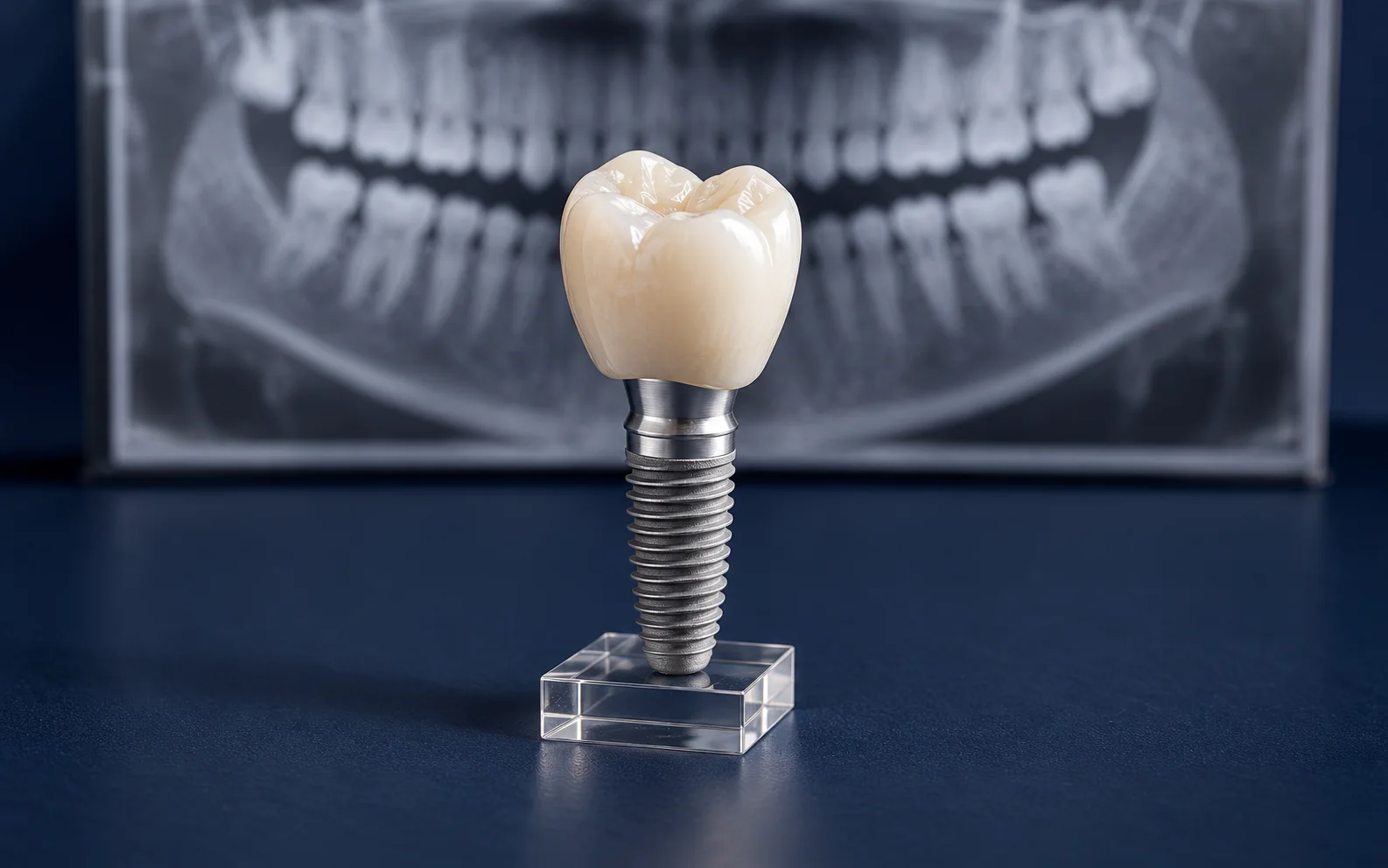

An implant cannot decay, but the tissue around it can
An implant is a titanium screw placed in the jawbone. The bacteria behind tooth decay cannot damage titanium, so the implant itself never develops a cavity. The screw is not left bare, though: gum wraps around it and jawbone holds it. How long it lasts depends on how healthy those two tissues stay.
In a natural tooth, a thin layer of connective tissue sits between the root and the bone. It absorbs some of the chewing force and holds inflammation back for a while. An implant has no such layer; the screw meets bone directly. Inflammation that starts at the gum margin therefore reaches the bone sooner.
There is no single answer to how many years
Nobody can say in advance how many years an implant will last. The same screw, the same dentist and the same crown give different results in two people. Oral hygiene, smoking, the state of the bone and the chewing load all vary from person to person, and every one of them shifts the timeline. That is why no implant can honestly be called a lifetime solution.
Peri-implantitis progresses quietly
Disease around an implant develops in two steps. First the gum becomes inflamed: it bleeds when you brush, looks red and feels puffy. At this stage no bone has been lost and the picture can still be reversed. Left untreated, the inflammation reaches the bone, and bone that has dissolved does not grow back on its own.
The hard part is that this rarely hurts. There is usually no warning signal of the kind a toothache gives, and by the time an implant feels loose the bone loss is already advanced. Bleeding when you brush, a gum margin that has receded, or a gap appearing at the edge of the crown are the early warnings. If you notice one of them, do not put off seeing a dentist. If swelling spreads into the face, or comes with a fever or discharge, seek dental care the same day.
Daily cleaning is the habit that changes most
The crown on an implant has a slightly different shape from a natural tooth and can leave a ledge at the gum margin that is awkward to reach. Plaque collects there. Brushing twice a day is not enough on its own; the gaps between the teeth need cleaning separately every day.
- Brush twice a day with a soft brush, angling the bristles towards the gum margin.
- Use an interdental brush or floss daily; plaque builds up most in those gaps.
- Let a dentist pick the size of the interdental brush; one forced into place injures the gum.
- A water flosser sits alongside interdental cleaning rather than replacing it.
- If part of the crown is impossible to clean, say so at the next check.
Smoking and conditions that are not under control
Smoking reduces blood flow in the gum and weakens its defence against inflammation. Bone loss around implants is seen more often in smokers and progresses faster. Healing is also harder when blood sugar runs high for long stretches; in people whose diabetes is well controlled, that extra risk largely falls away. Some medicines that act on the gum change the picture as well.
Each risk looks small on its own; what really strains the tissue around an implant is the way they stack up together.
How grinding loads an implant
A natural tooth gives way a little under heavy load, and most people feel it happen. An implant has no such give, so the force passes straight into the screw and the bone. Loose screws, chipped porcelain and fractured abutments (the connecting piece between the screw and the crown) turn up more often in people who grind at night. A night guard is the usual way to take some of that load off.
What happens at a check
Checking an implant is not the same as checking a tooth. The gum pocket is measured with a fine probe, any bleeding is noted, and the depth is compared with the last reading. An X-ray taken at set intervals shows the bone level around the screw; what is informative is not a single image but two taken from the same angle and compared.
The instruments used for cleaning differ too: softer tips are preferred over metal ones that scratch titanium, because plaque clings more easily to a scratched surface. The screw holding the crown is checked and retightened if it has worked loose. The interval is not the same for everyone; smokers and people who have already lost bone are seen more often.
Frequently asked questions
Can a dental implant decay?
A titanium screw cannot decay, and the bacteria behind cavities do it no damage. The gum and bone around the screw can still become diseased, though. The commonest reason implants are lost is not decay but inflammation spreading through those tissues.
Will an implant last a lifetime?
No implant can be promised to last a lifetime. Oral hygiene, smoking, the state of the bone, the chewing load and how regularly the implant is checked all shape the timeline together. Because those factors differ so much between people, putting a number of years on it in advance is not honest.
How would I notice peri-implantitis?
It rarely hurts, so the early signs matter: bleeding when you brush, redness and puffiness at the gum margin, a receding gum line, or a gap opening at the edge of the crown. An implant that feels loose is a late finding, and bone loss is well advanced by then.
Does smoking really affect implants?
Yes. Smoking reduces blood flow in the gum and weakens its defence against inflammation. Bone loss around implants is seen more often in smokers, and it progresses faster. After stopping, the ability of the tissue to heal returns over time.
Can grinding damage an implant?
Grinding alone rarely costs someone an implant, but it raises the load on the screw and on the porcelain of the crown. Loose screws, chipped porcelain and fractured abutments are more frequent in people who grind. A night guard is commonly used to reduce that load.
How often should an implant be checked?
There is no single interval that suits everyone. A check every 6–12 months is enough for many people, while smokers and those who have already lost bone are seen more often. The dentist who examines your mouth sets the interval.
This content is for general information only and does not replace an examination.
Edited by
Elif Teke
Medically reviewed by: Ozan Ergen, Specialist in Oral, Dental and Maxillofacial Surgery
This article draws on the clinical experience of the Papatya Dental team and is reviewed for accuracy before publication.
- Last updated:
- 2026-09-21
- Editorial contact:
- icerik@papatyadental.com