
What fluoride does to enamel
When the bacteria in plaque meet sugar they make acid, and that acid pulls minerals out of enamel. Fluoride steps into the same cycle twice: it speeds up the return of those minerals, and the enamel that rebuilds holds up a little better against the next acid attack. Brushing lifts the plaque away, fluoride slows the loss underneath. They are two different jobs, which is why one does not stand in for the other.
What the argument is actually about
The debate comes down to two things: the total amount taken in each day and the age at which it is taken in. Small children swallow part of what goes on the brush, and if the tap water is fluoridated or drops are given as well, the total climbs. The stretch in which that total matters is narrow: the years when permanent teeth are still forming inside the jaw.
- How much: the size of the smear and the ppm figure on the tube decide it together.
- At what age: what matters is the years when the teeth are forming inside the jaw.
- What else counts: fluoridated water, drops or tablets add to the same daily total.
How much paste at each age
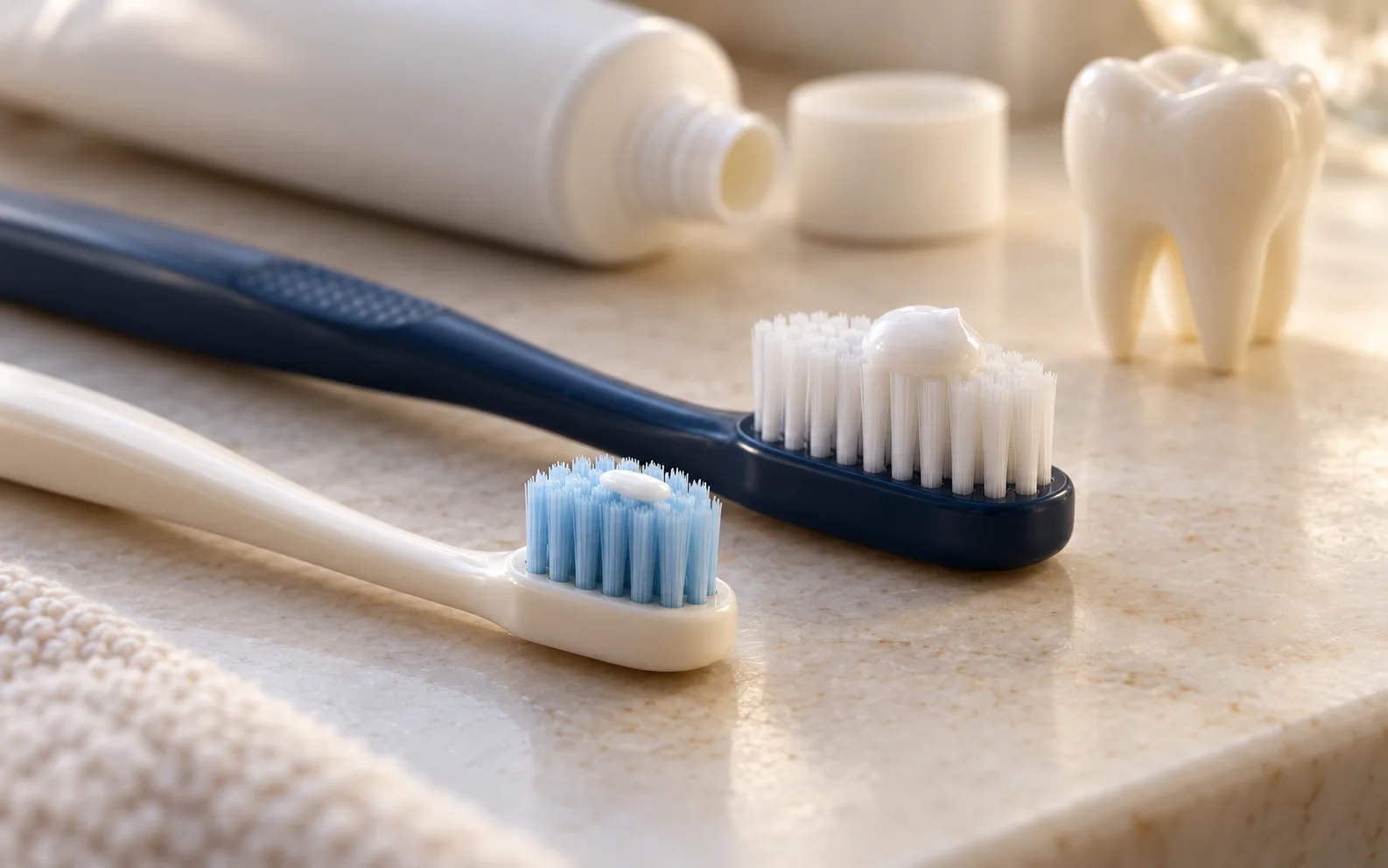
The usual advice is to adjust the amount rather than drop fluoride altogether, because the protection comes from the fluoride itself. If an adult watches a child brush until about six, both the amount of paste and how much is swallowed stay in view, and a habit that has settled in is harder to change later.
- Up to age 3: a rice-grain smear of a 1000 ppm paste.
- Ages 3–6: a pea-sized amount, 1000–1450 ppm.
- From 6 onwards: a pea-sized amount, 1350–1500 ppm.
- Adults: a pea-sized amount twice a day, 1350–1500 ppm.
What dental fluorosis is, and when it forms
Fluorosis is a change in the colour and surface of enamel that follows a long stretch of too much fluoride while that enamel is being laid down. In most cases it stays very mild: faint white flecks or lines you would have to look for. In mild fluorosis the tooth is not weaker and does not decay any faster, so the issue is appearance; in the rare severe forms the enamel surface can break down, and that is something for a dentist to assess at an examination. Timing is the deciding part, because permanent teeth finish forming at around eight, and after that fluoride can no longer cause fluorosis.
What a fluoride-free paste changes
A fluoride-free paste still cleans plaque off and leaves the mouth fresh; what goes missing is the support for putting minerals back into enamel. Some brands replace fluoride with other ingredients, but their place in preventing decay is nowhere near as well known. If you would rather avoid fluoride, say so at your next check-up. Brushing habits, how often sugary snacks come round and the interval between check-ups can then be looked at together.
Rinsing with water straight after brushing washes away the fluoride the paste has only just left behind; spitting out the excess and leaving it there keeps more of it on the tooth.
Who gets more out of fluoride than others
Risk is not spread evenly. A dry mouth loses much of the diluting and buffering that saliva normally does; with fixed braces the area around each bracket is hard to clean; where the gum has receded, the exposed root surface is softer than enamel and decays faster. Frequent snacking multiplies acid attacks through the day. In situations like these a dentist may raise the option of a higher-fluoride paste or a fluoride varnish painted on in the surgery.
Frequently asked questions
Is fluoride toxic?
It depends on the amount. The pea-sized smear used for brushing is regarded as safe in daily use. Trouble comes from unusual quantities, such as swallowing most of a tube at once, which is why paste is kept out of reach where there is a small child in the house.
Can I use a fluoride-free paste for my child?
You can, though fluoride is the ingredient whose protection against decay is well established, and a paste without it does not give that support. The common approach is a small, age-appropriate amount rather than none at all. Talk it over with your dentist, because a history of decay changes the picture.
Are white marks fluorosis or early decay?
Both can look white, but they sit in different places. Fluorosis marks tend to be symmetrical and spread across the tooth, while an early decay spot shows up on its own along the gum line or between two teeth. Telling them apart needs an examination.
Should I change paste if the tap water is fluoridated?
There is no need to drop the ppm of the paste; the difference lies in how much goes on the brush and how much is swallowed. Drops or tablets do add to the same daily total, so any extra supplement is something for a dentist to decide, not a choice made at the shelf.
Does fluoride still help adults?
Yes. Fluoride works on enamel that is already in the mouth, not only on teeth that are forming, and every brushing leaves a thin reserve on the surface. Where gums have receded it matters more still, because the exposed root decays more readily than enamel.
This content is for general information only and does not replace an examination.
Edited by
Elif Teke
Medically reviewed by: Canan Kale, Specialist in Paediatric Dentistry
This article draws on the clinical experience of the Papatya Dental team and is reviewed for accuracy before publication.
- Last updated:
- 2026-09-21
- Editorial contact:
- icerik@papatyadental.com