
Fluoride in water: three different pictures
Drinking water around the world falls into three broad situations. In some places fluoride is added to the mains supply and the level is held within a set range. In others nothing is added and the water's natural fluoride is low as well. In a third group of places nothing is added either, but the water is naturally rich in fluoride, and there the issue is excess rather than shortage. Two cities in the same country can fall into different groups.
Why fluoride is a water question at all
Most of what fluoride does for a tooth happens on contact: while it sits on the surface, it slows the loss of minerals from enamel and helps the surface harden again. Toothpaste does this twice a day at a high concentration. Drinking water, by contrast, leaves a very low level in the mouth throughout the day. Neither replaces the other; the total is what counts, and part of that total depends on where you live.
Fluoride behaves less like a dose and more like a background: a small amount present in the mouth all day does more than a large amount taken rarely.
The tap changes, the routine does not
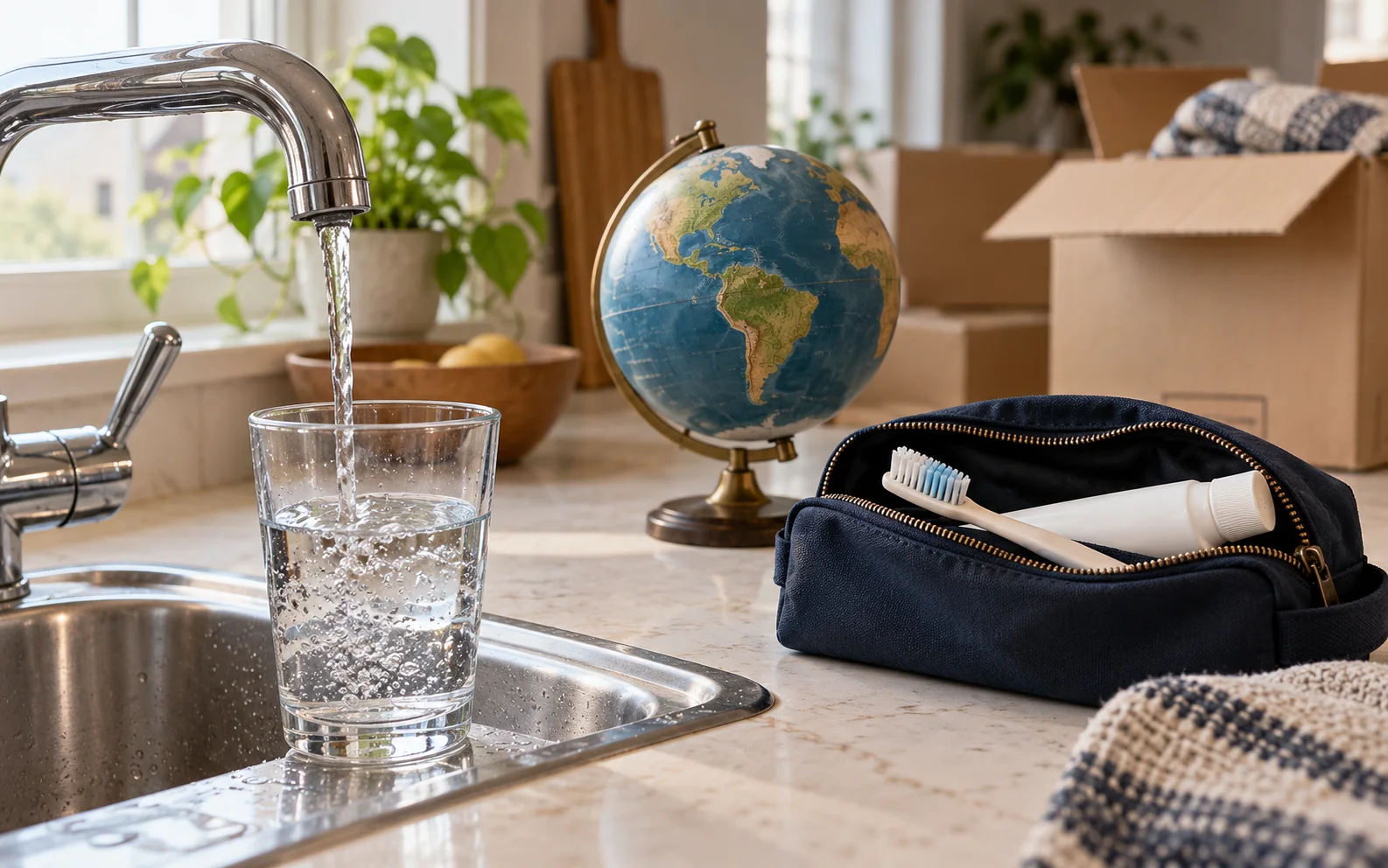
When you move abroad, your brush, your toothpaste and your habits travel with you unchanged. What changes is invisible: what comes out of the tap, whether you drink it at all, and what the kitchen filter takes out. In an adult, going from a fluoridated supply to an unfluoridated one shows up in decay only over years. In the other direction, a family settling in a naturally fluoride-rich area takes in more fluoride than expected, and that matters most for the youngest children.
- The annual water quality report from the local supplier gives the fluoride figure, and in most places it is published on the utility's own website.
- Whether the household actually drinks tap water, or buys bottled water instead.
- If there is a treatment unit in the kitchen, the deciding factor is which type it is.
- For children: the fluoride concentration of the toothpaste and the amount used.
Bottled water and filters
Fluoride in bottled water differs markedly between brands. Some contain almost none; certain natural mineral waters reach several milligrams per litre. In Europe, a natural mineral water above 1.5 mg/L must state on the label that it is unsuitable for regular consumption by infants and young children. With filters, the type decides the answer: reverse osmosis and distillation remove most of the fluoride, carbon filters generally do not, and water softeners are not aimed at fluoride at all.
Toothpaste and extra fluoride for children vary by region
Children's toothpastes are not identical from one country to the next, and neither is the guidance on how much to use; national advice is written with the local water in mind. The same holds for fluoride drops and tablets: they come up where the water carries little fluoride and decay risk is high, and they do not where the water is naturally rich in it. So at a first dental visit in a new country, saying what the household drinks is useful even if nobody asks. Swallowed toothpaste counts too: too much fluoride while teeth are still forming can leave faint white marks on the adult teeth.
How to read the debate
Countries differ for reasons that go beyond dentistry. In some places water arrives through many small networks and central dosing is technically awkward. In others, adding any substance to public water is a legal question in its own right. Some countries put fluoride into table salt or milk instead. No side is taken here between those arrangements; whichever one you live under, knowing what your own tap delivers is the part left to you.
Frequently asked questions
How do I find out whether my water is fluoridated?
The most direct route is the annual water quality report from the local supplier, where fluoride is usually listed on its own line in mg/L. If the report is hard to find, the utility can be asked in writing. If the household drinks bottled water, the figure that counts is the one on the label, not the one for the mains.
Is fluoride toothpaste enough where the water has none?
For most adults, brushing twice a day with fluoride toothpaste is the main source, and that is the usual arrangement in countries that do not fluoridate. Where decay risk is high, a dentist may consider a higher fluoride toothpaste or a varnish applied in the surgery.
Does bottled water contain fluoride?
It can, but the amount varies a great deal by brand. Some spring waters carry almost none, while certain natural mineral waters reach several milligrams per litre. In Europe, a mineral water above 1.5 mg/L must say on the label that it is unsuitable for regular consumption by infants and young children.
Do water filters remove fluoride?
Jug filters and carbon filters fitted to the tap generally do not; reverse osmosis and distillation are the exceptions. To check your own unit, look in its manual or data sheet for the list of substances it reduces: if fluoride is not named there, assume it stays in the water. A reverse osmosis unit also performs as stated only if its filters and membrane are replaced at the intervals the manufacturer gives.
Does my child need fluoride drops or tablets?
That varies by region and by child. If your child was already taking drops or tablets before the move, do not simply continue them in the new country: the water there may already supply enough fluoride. A home on a private well is a special case, as its fluoride level stays unknown until the water is tested. The judgement belongs to a dentist or paediatrician who knows what the household drinks.
What does living in a naturally high-fluoride area mean for teeth?
Taking in too much fluoride over a long period while teeth are still forming in the jaw can leave faint white marks on the adult teeth, and in marked cases brown staining and a rough surface. Once the teeth are through and finished, this no longer develops. In such an area it is worth knowing the fluoride in the water young children drink, and infant formula is usually made up with a low-fluoride water.
This content is for general information only and does not replace an examination.
Edited by
Elif Teke
Medically reviewed by: Canan Kale, Specialist in Paediatric Dentistry
This article draws on the clinical experience of the Papatya Dental team and is reviewed for accuracy before publication.
- Last updated:
- 2026-09-21
- Editorial contact:
- icerik@papatyadental.com