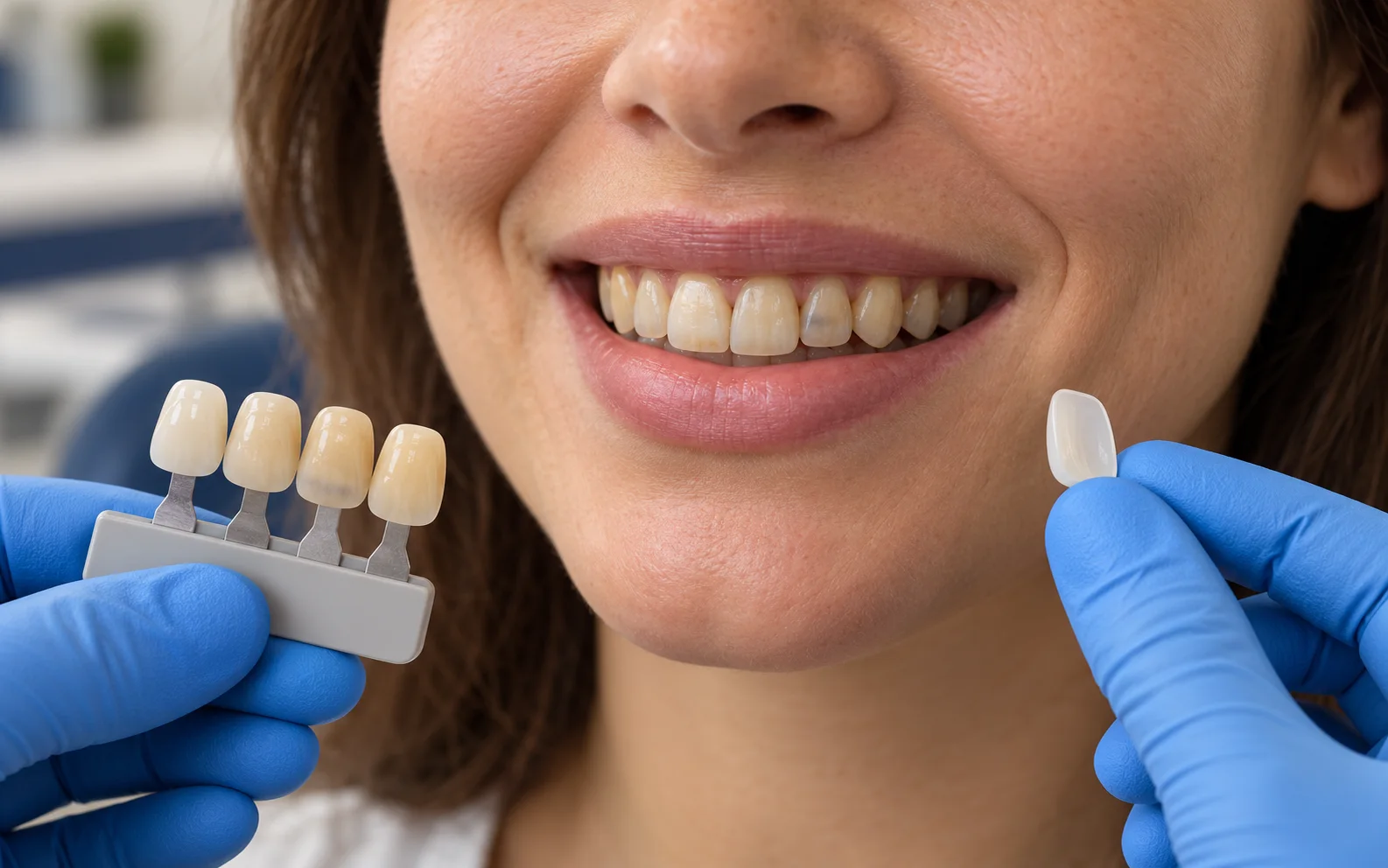

Why whitening makes teeth sensitive
Whitening gels contain peroxide. It passes through the enamel and reaches the dentine underneath. Dentine is threaded with very fine tubules that run towards the living tissue in the middle of the tooth. As peroxide travels along them, that tissue is more easily irritated for a while. The short, sharp, needle-like twinge you feel comes from there. The tooth has not been worn down or damaged.
How long the twinges last
For most people the sensation starts on the day of the appointment and drops off noticeably within 24–48 hours. It usually clears within a week. With tray whitening done at home the feeling spreads across more days but stays milder. After a single strong session in the chair, the first hours can be more intense. These timings vary from person to person: enamel thickness, receding gums and any history of sensitive teeth all change the picture.
What actually helps
The two ingredients that do most of the work are potassium nitrate and fluoride. Potassium nitrate slows the nerve ending down so that less of the signal is passed on, while fluoride narrows the openings of the dentine tubules. Toothpastes made for sensitive teeth commonly combine the two for that reason.
- Rubbing a little sensitivity toothpaste onto the tooth with a fingertip after brushing, and leaving it without rinsing, helps it work better.
- A short break between sessions also helps.
- Put off anything very hot or very cold for a few days. Warm water and warm soup cause no trouble.
- Use a soft brush and light pressure; scrubbing hard leaves more dentine exposed.
- Acidic drinks leave the enamel more vulnerable in the days right after whitening.
When it is not ordinary sensitivity
Sensitivity from whitening is common and passes on its own, as does a gum margin that turns white for a few hours where the gel touched it. Not every ache comes from the gel, though. Some symptoms point to something else inside the tooth, and those do not settle by themselves.
- Pain that carries on for days and grows instead of fading.
- Pain that stays in one single tooth. Whitening sensitivity is usually felt across several teeth at once.
- A throbbing ache that starts on its own, with nothing eaten or drunk.
- Pain triggered by heat that lingers for minutes after the heat is gone.
- Gums that are swollen or keep bleeding.
Lowering the risk before you start
How strong the sensitivity turns out to be is largely settled before the gel goes on. Decay should be filled, tartar removed and any receding gums assessed first. An exposed root has no enamel over it and reacts far more sharply during whitening. Anyone whose teeth are already sensitive usually has an easier time if they start on a potassium nitrate toothpaste a few weeks beforehand.
Carrying on once teeth feel sensitive
Feeling a twinge does not mean the whitening has gone wrong, and feeling more does not mean the teeth are getting whiter. Pausing does not undo the shade already gained; it only delays reaching the one you were after. So when the ache builds up, cutting the wearing time or leaving a day or two between sessions is a safe thing to try.
Frequently asked questions
When is the sensitivity strongest, and does it return with every session?
The sharpest hours are usually the ones right after the gel comes off, and things settle noticeably overnight and through the next day. The feeling can return after each session, but it does not stack up from one session to the next. If every session hurts more than the last, that is worth telling the dentist running the treatment.
When should toothpaste for sensitive teeth be started?
Starting a few weeks before whitening and using it twice a day in place of ordinary toothpaste is the usual approach. The effect builds over days rather than in a single brushing. If a fortnight of regular use changes nothing, the sensitivity may be coming from somewhere else and a dentist should look at it.
Does whitening thin the enamel for good?
At the strengths used under dental supervision, whitening is not thought to thin enamel to any measurable degree. The sensitivity comes from peroxide reaching the living tissue through the dentine tubules, not from lost enamel. Frequent repeat courses combined with acidic drinks are a separate matter and do wear enamel down.
Will my fillings and crowns turn sensitive too?
The colour of fillings and crowns does not lighten with peroxide. If there is a hairline gap at the edge of a filling, though, gel can seep in and give a sharp twinge. Strong pain in one filled tooth after whitening is a reason to have that filling checked.
What is easier to eat after whitening?
For the first few days the rule is simple: warm and low in acid. Water, soup, yoghurt, banana and rice cause no trouble. Iced drinks, very hot coffee, lemon, vinegar and fizzy drinks are worth putting off. Sticking to pale-coloured food on the first day also cuts down on fresh staining.
This content is for general information only and does not replace an examination.
Edited by
Muhammet Buğra Şener
Medically reviewed by: Nilufar Tulanova Şener, Dentist, Aesthetic Dentistry
This article draws on the clinical experience of the Papatya Dental team and is reviewed for accuracy before publication.
- Last updated:
- 2026-09-21
- Editorial contact:
- icerik@papatyadental.com