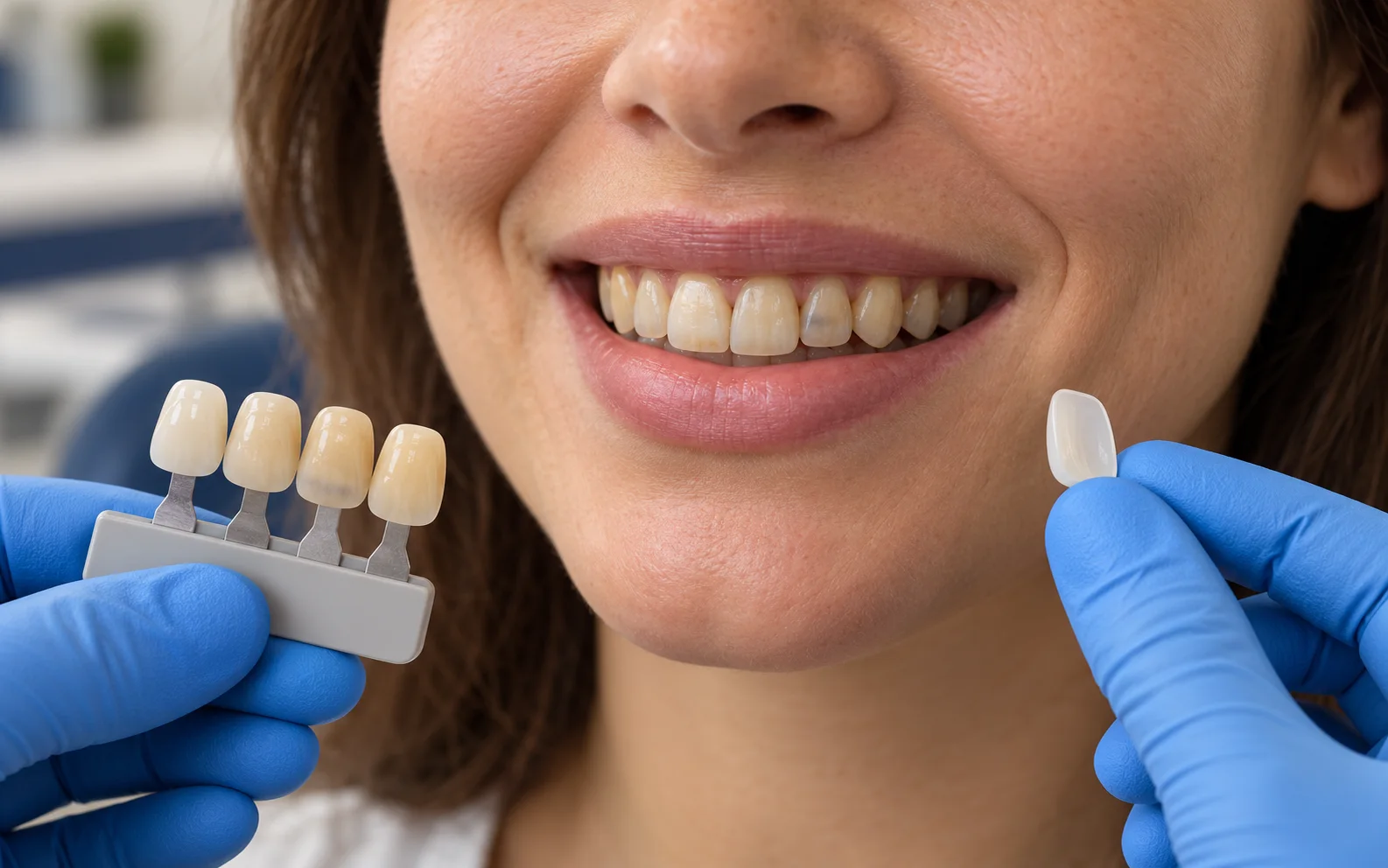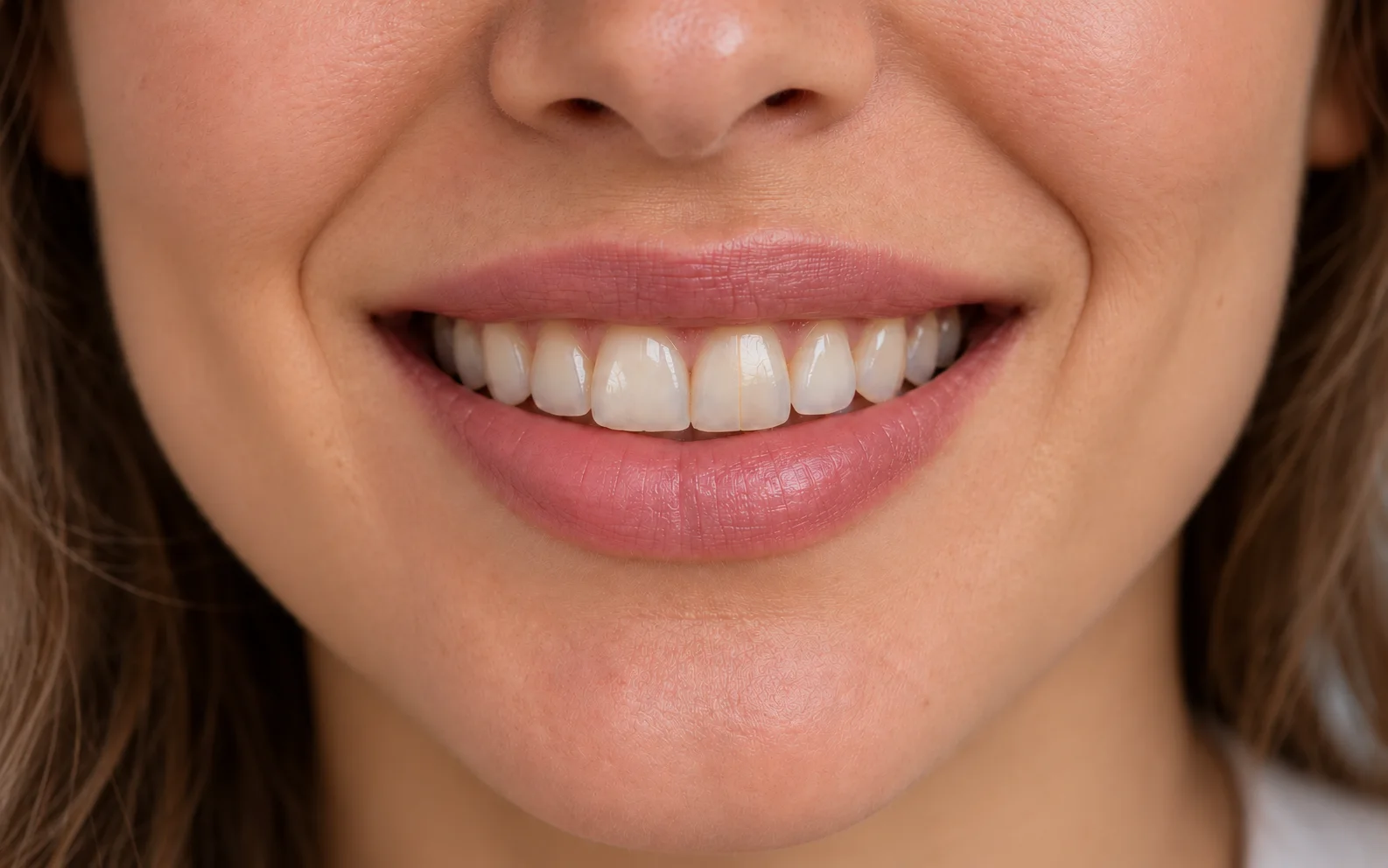

The eye reads the whole, not one tooth
When you look at a smile, the eye does not separate the teeth one by one. The line traced by the edges of the upper teeth, how much gum shows when you smile, and how the teeth sit against the lower lip are all read together. So a tooth that looks out of proportion on its own often goes unnoticed within the whole. The reverse holds too: teeth whose individual measurements are fine still look unnatural if the edge line runs unevenly. Facial harmony rests largely on how that whole is read.
The width-to-length ratio of the front tooth
The two teeth at the centre of the upper jaw are the most visible part of a smile, and proportion is discussed on them more than anywhere else. What is measured is the visible width of the tooth against its length. In most people that ratio falls between 75% and 85%, so the tooth is a little narrower than it is long. The smaller the figure, the longer and more slender the tooth looks; the larger it is, the shorter and wider. This is an observation and not a target: the same ratio looks different on different faces and varies from person to person.
- The ratio compares the width of the tooth with its own length, not with the neighbouring tooth or the width of the face.
- If the gum line sits lower, the visible length shortens, the ratio rises and the tooth reads wider.
- Wear shortens the biting edge and has the same effect: the tooth looks squarer.
- When the two front teeth differ noticeably in ratio, the eye picks that up before it notices the shape of either one.
Square, rounded, triangular: the difference in form
The corners and side outlines of a tooth define its form. In a square form the biting edge runs flat and the corners are defined; the flat area on the front surface stays wide, so the tooth looks larger. In a rounded form the corners soften and the tooth looks slightly smaller and gentler. A triangular form is narrow at the gum and wide at the edge, and small triangular gaps near the gum, often called black triangles, can open up between the teeth. All three occur naturally and none of them is more correct on its own.
Where the midline runs
The midline is the vertical line between the two upper front teeth, and it is compared with the centre of the face. A sideways shift of 1–2 mm is common, and most people do not notice it even in their own photographs. What catches the eye is something else: a tilted line. A midline that has shifted sideways but stays vertical usually goes unnoticed, while a line tipped by the same amount is spotted at once. The upper and lower midlines matching exactly is not the expected finding either; in most people the two do not line up.
Matching teeth to face type is not a rule
The idea that a square face takes square teeth and an oval face rounded ones has been discussed in dentistry for a long time and gives planning a starting point. It is not a correspondence that holds for everyone: two people with the same face type can have completely different natural tooth forms. Applied as a rule, the match ends in a template rather than in that particular face. Your own older photographs are a firmer place to begin; the shape of a tooth before it wore down says more than any table of face types.
A detail that jumps out in a photograph is usually invisible in conversation; a smile is read in movement, not in a frozen frame.
Wear changes the form over the years
The edge of a tooth shortens over the years and the form changes with it. As the length drops, the width-to-length ratio rises, the corners flatten and the tooth looks squarer. Over the same period less of the upper teeth shows at rest and more of the lower teeth comes into view. Grinding, acidic drinks and stomach acid reaching the mouth all speed this up. If stomach acid often reaches your mouth, mention it to your doctor as well; while the cause continues, so does the wear. If an edge is shortening quickly, turning translucent or chipping, see a dentist; rebuilding the form early means removing less tooth tissue. For people who grind at night, a night guard is one of the options that may come up.
Frequently asked questions
Is there one ideal width-to-length ratio for a front tooth?
No. In most people the ratio falls between 75% and 85%, but that is an observed range rather than a target. A tooth with the same ratio can look longer on a narrow face and shorter on a wide one. What matters more than the measurement of a single tooth is how it relates to its neighbours and to the line of the smile.
Do square teeth or rounded teeth look more natural?
Both are natural. A square form makes a tooth read slightly larger and more defined, a rounded form slightly smaller and softer. Small details at the corners often decide it: corners wear down over the years, so crisp, unworn corners on one tooth can look artificial when the neighbouring teeth are worn. A form that suits one person can look artificial on another.
My midline is slightly off. Does it need correcting?
A sideways shift of one or two millimetres is common and usually goes unnoticed; on its own it is not counted as a problem. A tilted line, or a shift that is clearly increasing, is a different matter and may be linked to the bite. That is settled by an examination, not by the measurement itself.
Why do my teeth look shorter than they used to?
Wear is the most frequent reason: the biting edge shortens over the years and the tooth looks squarer. A gum line that has receded, or gum that covers more of the tooth than before, also changes the visible length. Comparing an older photograph is a practical way to see how quickly the change is progressing.
Is tooth form chosen according to face shape?
The match between face type and tooth form is used as a starting point, but it is not a fixed rule. A firmer place to begin is the person themselves: an older smiling photograph that shows the length and corners of the teeth before they wore, together with the form of the remaining teeth, shows which form belongs to that face better than any table.
Can the form of a worn tooth be restored?
The length and form of a shortened edge can usually be brought back; which approach suits you depends on how much has been lost, on the bite and on how much tooth tissue remains. Done early, less tissue has to be removed. If whatever caused the wear is still going on, correcting the form alone will not be enough.
This content is for general information only and does not replace an examination.
Edited by
Eren Koluaçık
Medically reviewed by: Şerife Nur Kerpiçci, Dentist, Aesthetic Dentistry
This article draws on the clinical experience of the Papatya Dental team and is reviewed for accuracy before publication.
- Last updated:
- 2026-09-21
- Editorial contact:
- icerik@papatyadental.com