


How Long Veneers Last: What the Studies Show
Porcelain and E-max veneers usually last more than ten years: a 2021 systematic review of 25 clinical studies, covering 6,500 porcelain veneers, estimated that 95.5% were still in place after ten years. A meta-analysis published in 2025 compared ceramic materials and found survival of about 96% for feldspathic porcelain and 97% for lithium disilicate (E-max) at around ten years, with no difference between the two.
Fewer studies follow veneers for twenty years, but the ones that do are encouraging. In a study at the Medical University of Innsbruck in Austria, 93.5% of 318 porcelain veneers were estimated to survive ten years and 83% twenty years. A study of 499 feldspathic veneers bonded to enamel reported 91% survival at twenty years. A review of the evidence notes that there is still no reliable estimate for veneers beyond twenty years.
Composite veneers are a different case. They are made of tooth-coloured resin, are bonded with little or no drilling and are easier to repair, but the surface wears and stains over time. In a 2023 meta-analysis of clinical trials, 88% of composite veneers were still in place after two to eight years, and rough surfaces, colour mismatch and staining at the edges were the most common problems.
Survival figures count a veneer as surviving while it is still on the tooth, so they do not tell the whole story. A veneer can stay in place for fifteen years and still need attention: a small chip, a dark line at the edge or a gum line that has moved back can all change how it looks.
Fracture appears to be the most common reason a ceramic veneer fails, followed by the veneer coming loose, and both happen most often in the first years after it is fitted. This is where the bond matters. Ceramic bonds most reliably to enamel, so the less enamel is removed and the less of the softer dentine underneath is exposed, the better the long-term result; a 2024 review of 55 studies found that exposed dentine clearly lowers the success of ceramic veneers. In the 2021 review of 6,500 veneers, veneers that covered the biting edge of the tooth failed less often than veneers that stopped short of it. Grinding also has a large effect: in the Innsbruck study of 318 veneers, veneers in patients who ground their teeth were 7.7 times more likely to fail.
Papatya Dental Clinic is in Konyaaltı, Antalya, on Turkey's Mediterranean coast. It welcomes patients from the UK and elsewhere in Europe, and many of its enquiries come from the US. A common question before a smile design is how long veneers last, and whether veneers made in Turkey last as long as veneers made at home. The answer depends on the same factors in both countries: the material, the bond, how much enamel is kept and how the veneers are looked after.
Porcelain veneers (all types)
An estimated 95.5% still in place after ten years, in a review of 6,500 veneers.
E-max veneers
About 97% survival at around ten years, similar to feldspathic porcelain (96%), with far fewer technical problems (6.1% compared with 41.5%).
Composite veneers
88% still in place after two to eight years; they wear and stain sooner.
Twenty years
An estimated 83–91% of porcelain veneers still in place in two long-term studies.
Grinding
7.7 times the risk of failure in one long-term study, which is why a night guard is usually advised.
Patient stories
In their own words
Patients who travelled to Antalya talk about their treatment, their days at the clinic and the moment they first saw their new teeth. Each story is that patient's own experience; your plan is decided after your examination.
David from Nottingham talks through his whole treatment in an eight-minute interview: the first consultation, implant surgery, recovery and his new smile. Read the story
Who Gets the Longest Life From Veneers?
Veneers last longest on healthy teeth with plenty of enamel, in people who do not grind their teeth and who keep their gums healthy. These are the conditions that favour a long life, and the points your dentist checks before recommending veneers at all.
Healthy teeth with plenty of enamel
Ceramic bonds more reliably to enamel than to dentine, and a 2024 review of 55 studies found that exposed dentine lowers the success of ceramic veneers, so teeth that need only a thin preparation give them a good start.
A bite that does not overload the front teeth
When the front teeth are not taking the force of grinding or an edge-to-edge bite, chips and breaks are less likely.
Healthy gums
Gums without inflammation stay at the same level for longer, so the edges of the veneers stay hidden.
Good daily cleaning
Brushing, cleaning between the teeth and regular hygiene visits protect the tooth at the edge of each veneer.
Enamel and preparation
How much of each tooth would need to be prepared, and whether thin or no-preparation veneers are possible.
Signs of grinding
Worn edges, cracks or a tired jaw in the morning point to grinding, which changes the plan.
Root-treated teeth
A tooth that has had a root canal has often lost more of its structure and can darken; in a study that followed 318 veneers at the Medical University of Innsbruck for up to twenty years, veneers on such teeth failed more often.
Fillings, decay and gums
Decay and gum problems are treated first, and large old fillings may make a crown the better choice.
Heavy grinding without protection
If you grind your teeth and would not wear a night guard, veneers are at much higher risk of breaking.
Teeth that are heavily filled or broken
A crown, which covers the whole tooth, usually does better on a tooth with little healthy structure left.
Untreated decay or gum disease
These are treated before veneers are planned; otherwise the edges of the veneers are at risk from the start.
What Shortens the Life of Veneers
Fracture, the veneer coming loose, grinding, decay at the edges, gum recession and staining at the edges are the main things that shorten the life of veneers. Knowing them helps you avoid them, wherever your veneers were made.
Fracture and chipping
The most common reason ceramic veneers fail. Grinding, biting hard objects and a heavy bite on the front teeth make it more likely.
Coming loose
The second most common reason ceramic veneers fail, after fracture. The bond is strongest on enamel and weaker where a lot of dentine has been exposed.
Grinding and clenching
In one long-term study, grinding made failure 7.7 times more likely. A night guard takes the load off the veneers while you sleep.
Decay at the edges
The tooth at the edge of a veneer can still decay, although in the 2021 review of 6,500 veneers this was a rare reason for failure.
Gum recession
If the gums move back, the edge of a veneer can show; gum disease and very hard brushing make this more likely.
Staining at the edges
More common with composite veneers and in smokers; in a study that followed 318 veneers in Austria for up to twenty years, staining at the edges was clearly worse in people who smoked.
Preparation cannot be undone
Enamel removed for a veneer does not grow back, so a tooth that has been prepared will normally always need a veneer or crown. In the 2021 review of 6,500 veneers, an estimated 1 in 100 failed within ten years because the tooth needed root canal treatment.
How Veneers Are Planned to Last
Most of what decides the life of a veneer happens before it is bonded. In Antalya, the treatment itself usually takes 1–3 days for laminate (thin porcelain) veneers and 3–5 days for E-max veneers, and most patients plan a stay of about a week.
- 1
Before you travel
You send photos and any recent X-rays, and the clinic's dentists prepare an online assessment and a draft plan. Your coordinator explains the plan, the dates and how many days you need. If you would rather meet in person first, the clinic's offices in London (25 Southampton Buildings) and Helsinki offer consultations and treatment planning; all treatment is carried out in Antalya.
- 2
Examination and smile design
At the clinic your teeth, gums and bite are examined and a digital smile analysis is made; the shape, length and shade of the new teeth are then designed with you before any tooth is prepared.
- 3
Keeping enamel
Each tooth is prepared only as much as the chosen material needs, keeping the preparation in enamel wherever possible. Whether the veneer should cover the biting edge is decided at this stage.
- 4
Try-in
Try-ins let you check the shape, the shade and how the new teeth feel when you speak and bite.
- 5
Bonding
The veneers are bonded with an adhesive technique suited to the ceramic, and that bond is what holds them to the tooth for the long term.
- 6
Bite check
The bite is checked in every direction of movement, and if you grind your teeth, a night guard is worth discussing with your dentist.
- 7
Final check before you fly
A last check is done before you leave Antalya, and you take your cleaning and care instructions home with you.
Alternatives to Veneers
The main alternatives to veneers are teeth whitening, composite bonding, crowns and clear aligners. Which one suits you depends on how much of your own tooth you want to keep and what needs changing.
Teeth whitening
Lightens your own teeth with no preparation; the result fades gradually and can be topped up.
Composite bonding
Tooth-coloured resin added to the tooth, usually with no drilling; quick and easy to repair, but it stains and wears sooner.
Crowns
Cover the whole tooth and suit teeth that are heavily filled, root-treated or broken, but need much more preparation.
Clear aligners
Straighten crooked teeth instead of covering them, so less tooth needs to be prepared later, or none at all.
Veneer Materials and How Long Each Lasts
E-max (lithium disilicate) and feldspathic porcelain veneers both show about 96–97% survival at around ten years in clinical studies. Composite resin is quicker to place and easier to repair but wears sooner. Zirconia veneers are newer, and there is not yet long-term clinical data for them. The clinic works with ceramic systems from Ivoclar (the maker of E-max), VITA Zahnfabrik, Amann Girrbach and Zirkonzahn.
E-max (lithium disilicate)
A glass ceramic with high long-term survival and few technical problems.
Feldspathic porcelain
Very thin and translucent; long-term survival similar to E-max, with more chipping and repairs.
Composite resin
Built up on the tooth with little or no preparation; needs polishing and repairs sooner.
After Your Veneers: The First Weeks and the Years Ahead
Veneers do not need a recovery period in the way surgery does. The first weeks are when you get used to them, and the habits you build then decide much of how long they last.
- 1
First few days
Some sensitivity to hot and cold is common and usually settles. The new shape can feel unfamiliar when you speak.
- 2
First weeks
If anything catches or feels high when you bite, it can be adjusted. If you were advised to wear a night guard, make it part of your routine now.
- 3
First years
Chips and loose veneers happen most often in the early years, so regular check-ups matter most in this period.
- 4
The years after
At check-ups and hygiene visits, veneers are polished and their edges checked, and they are repaired or replaced only when they need it.
Cleaning
Brush twice a day with a non-abrasive toothpaste and clean between your teeth every day, as you would with your own teeth.
Habits that break veneers
Do not bite your nails, pens or ice, and do not open packets with your teeth.
Night guard
If you grind or clench, wear a night guard while you sleep.
Once you are back home
Papatya Dental Clinic follows up every treatment with 12 months of online aftercare, and your coordinator can be reached on WhatsApp.
A chipped or cracked veneer
Send a photo to your coordinator; small chips can often be polished or repaired.
A veneer that feels loose or comes off
Keep the veneer and contact the clinic before trying to stick it back yourself.
Sensitivity or pain that does not settle
Contact your coordinator, especially if it gets worse over time or one tooth hurts when you bite on it.
What Affects the Cost of Veneers Over the Years
Over the years, what veneers cost depends on the material, how often they need repair or replacement, the number of teeth and any treatment needed first. A fixed figure cannot be given before your teeth have been assessed; current prices are shared with you, together with your treatment plan, when you contact us. The first step is an online assessment: you send photos and any recent X-rays, and the clinic's dentists prepare a draft plan. You can pay by card, bank transfer or cash.
Material
E-max, porcelain and composite veneers differ in price and in how often they may need repair or replacement.
Number of veneers
A few front teeth and a full smile across both arches are planned and priced differently.
Treatment needed first
Gum treatment, fillings or whitening of the other teeth may be part of the plan.
Looking after them
Check-ups, hygiene visits and a night guard if you grind cost far less over the years than replacing veneers early.
How Long Do Veneers Last? Frequently Asked Questions
How long do veneers last?
Porcelain and E-max veneers usually last well over ten years: in a review of 6,500 porcelain veneers, 95.5% were still in place after ten years, and two long-term studies found 83–91% still in place after twenty. Composite veneers wear sooner; in a review of clinical trials, 88% were still in place after two to eight years.
Do E-max veneers last longer than porcelain veneers?
Their survival is similar: about 97% for E-max and 96% for feldspathic porcelain at around ten years in a meta-analysis published in 2025. E-max veneers had far fewer technical problems, such as chipping, over the same period.
How long do composite veneers last?
In clinical trials that followed composite veneers for two to eight years, 88% were still in place, so they usually need polishing, repair or replacement sooner than ceramic veneers. Their advantage is that they are quick to place and easy to repair.
Do veneers from Turkey last as long as veneers made in the UK or the US?
They can, because how long veneers last depends on the material, how much enamel is kept and how well they are bonded and looked after, not on the country. Check that you are getting veneers and not crowns: crowns cover the whole tooth and need much more of it to be removed, and the two are sometimes confused. Before you book, ask which one you are getting, which material is used and how much of each tooth will be prepared.
What makes veneers fail early?
The most common reasons are a fracture and the veneer coming loose, usually in the first years. Grinding your teeth, biting hard objects, a lot of exposed dentine under the veneer and root-treated teeth all raise the risk.
Can a chipped veneer be repaired?
Small chips can often be polished or repaired with composite. A larger fracture usually means the veneer is replaced. Composite veneers are the easiest to repair.
How many times can veneers be replaced?
There is no fixed number. Each replacement can mean removing a little more of the tooth, which is why keeping as much enamel as possible the first time matters, and why looking after your veneers pays off.
Can veneers last a lifetime?
Sometimes, but it is safer not to plan on it. Studies have followed porcelain veneers for around twenty years, and there is no reliable estimate beyond that. Looking after them well helps them last as long as possible.
Do veneers need to be replaced after ten years?
No. Veneers are not replaced on a schedule. They are replaced when they break, come loose or no longer look right, and many porcelain veneers are still in place after twenty years.
Can I have veneers if I grind my teeth?
Often yes, but grinding raises the risk of failure sharply: 7.7 times in one long-term study. Your dentist will usually advise a night guard, and with heavy grinding a different plan may be safer.
Do veneers stain?
Porcelain and E-max veneers resist staining well, but the edges can darken over time, especially in smokers. Composite veneers stain more easily and need polishing.
What happens if a veneer comes off when I am back home?
Keep the veneer, avoid biting on that tooth and send a photo to your coordinator on WhatsApp. Papatya Dental Clinic follows up every treatment with 12 months of online aftercare. Depending on what has happened, you are advised by your dentist in Antalya, referred to a partner aftercare dentist where one is available or invited back to the clinic.
Can I meet the team before I travel?
Yes. Papatya Dental Clinic has offices in London (25 Southampton Buildings) and Helsinki, where you can have a consultation and plan your treatment; all treatment is carried out in Antalya. The clinic also holds MeetUp events in cities in the UK and the US where you can meet the team in person. If you would rather start from home, send photos and any recent X-rays for an online assessment.
How many days do I need in Antalya for veneers?
The treatment itself usually takes 1–3 days for laminate (thin porcelain) veneers and 3–5 days for E-max veneers. Most patients plan a stay of about a week, so there is time for the smile design, try-ins and a final check before flying home.
Medical sources
View medical sources
Medically reviewed by
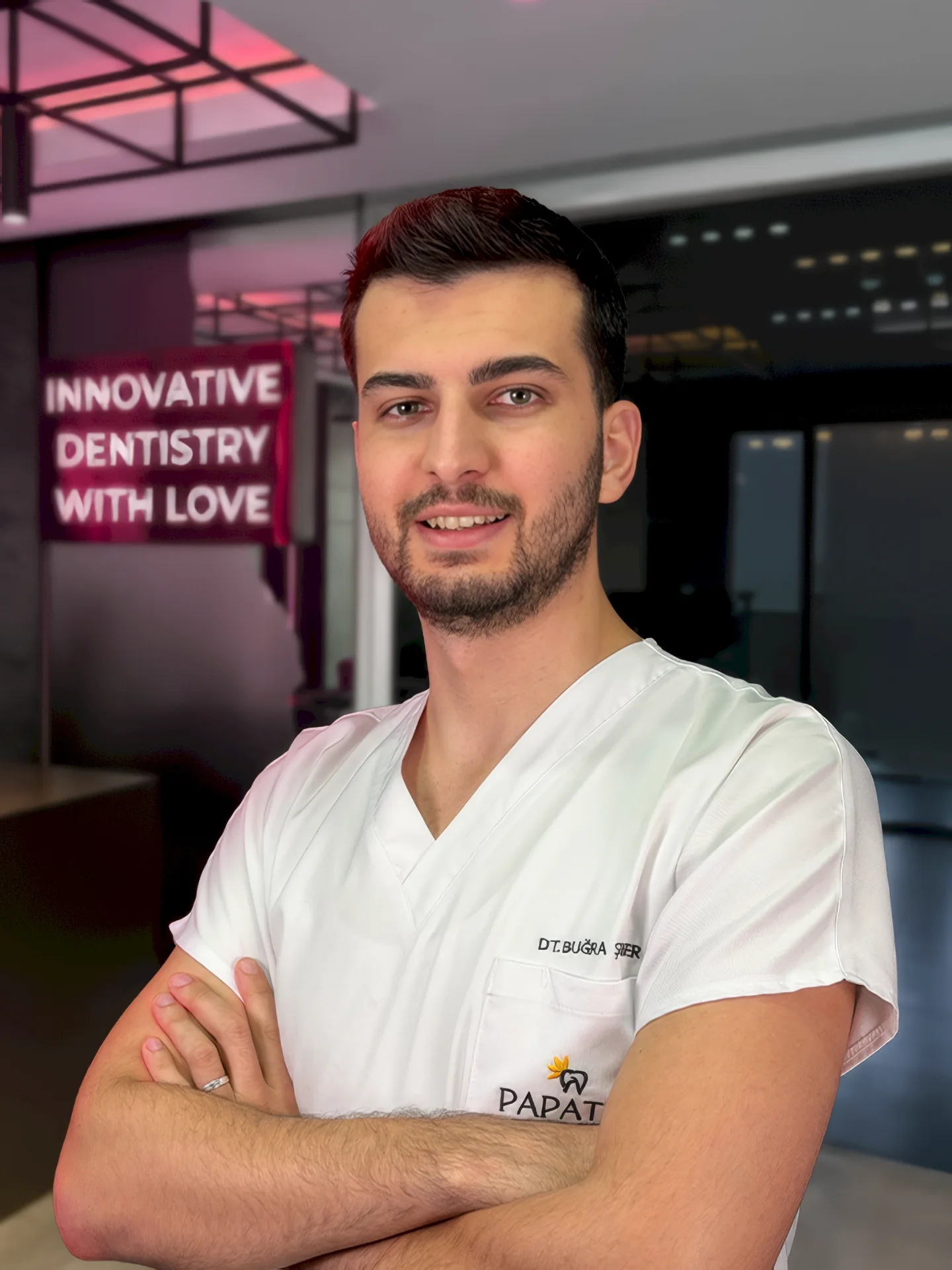
Muhammet Buğra Şener
Dentist, Aesthetic Dentistry
View doctor profile
Ahmet Metin Bal
Chief Dentist
View doctor profile
Şerife Nur Kerpiçci
Dentist, Aesthetic Dentistry
View doctor profileLast medical review: 26 October 2026