


How Long Crowns Last: What the Studies Show
A crown that is well made and looked after usually lasts more than ten years, and often much longer. One of the longest studies available followed 2,340 gold-alloy metal-ceramic crowns placed in a single specialist prosthodontic practice for up to 25 years. For crowns on teeth judged to have a good outlook when they were fitted, estimated survival was 97% at ten years and 85% at 25 years.
Crowns made of zirconia or E-max have been studied for a shorter time, but their five-year results are comparable with those of metal-ceramic crowns. A 2026 meta-analysis pooled 64 clinical studies of 3,509 metal-ceramic and 8,051 all-ceramic crowns. After five years, 98.5% of monolithic E-max (lithium disilicate) crowns, 97.3% of zirconia crowns with a porcelain layer, 97.1% of metal-ceramic crowns and 96.8% of monolithic zirconia crowns were still in place. A monolithic crown is made from a single piece of ceramic, with no layer of porcelain on top. Older feldspathic porcelain crowns did less well, at 90.4%.
For E-max there is longer data from one private practice: of 2,392 E-max restorations on back teeth, most of them full crowns, an estimated 96.5% were still in place after 16.9 years. The failures were fractures or large chips, and they happened on average 3.5 years after fitting. Most clinical studies of monolithic zirconia crowns cover five years or less, so its very long-term record is still being written.
What usually ends a crown's life after many years is the tooth or the gum underneath, not the crown. In a 25-year study of 2,340 metal-ceramic crowns, 101 of the 133 failures were biological, such as decay at the edge or trouble with the root. Only 8 were mechanical, and only 4 crowns had to be replaced because the porcelain broke. Another 22 were replaced after an average of 14 years because the patient no longer liked how they looked. In survival studies, a crown counts as surviving as long as it is still in place.
Root-treated teeth need particular care, because the tooth under the crown matters as much as the crown. A tooth that has had root canal treatment has often lost a good part of its structure to decay and to the treatment itself, and it has no nerve to warn you when something is wrong. A 2024 systematic review of 26 studies found that crowns on living teeth had the highest five-year survival, 98.3%. On root-treated teeth survival was lower: for example, 90.7% for metal-ceramic crowns held by a cast post and 91.3% with a fibre post. Yet a crown also helps a root-treated tooth last. In a study at the University of Iowa, root-treated teeth that were left without a crown were lost six times as often as teeth that were crowned. So a crown on a root-treated tooth is often the right decision, as long as there is enough tooth left to hold it.
Papatya Dental Clinic is in Konyaaltı, Antalya, on Turkey's Mediterranean coast. It welcomes patients from the UK and elsewhere in Europe, and many of its enquiries come from the US. Whether a crown made in Turkey lasts as long as one made at home depends on the same things in both countries: whether the tooth needs a crown at all, the health of the tooth underneath, how closely the edge of the crown fits, the material and the care the crown gets afterwards. At the clinic, crowns are designed and milled in its own CAD/CAM laboratory in Antalya.
Metal-ceramic crowns
An estimated 97% of crowns on teeth with a good outlook still in place at ten years and 85% at 25 years, in one specialist practice.
E-max crowns
98.5% of monolithic E-max crowns still in place after five years in a 2026 meta-analysis; 96.5% of E-max restorations on back teeth still in place after 16.9 years in one practice.
Zirconia crowns
96.8% (monolithic) and 97.3% (with a porcelain layer) still in place after five years in a 2026 meta-analysis, with fewer long-term studies.
Root-treated teeth
Crowns on these teeth fail more often than on living teeth, but in one study root-treated teeth left without a crown were lost six times as often as crowned ones.
Crowns on implants
96% still in place at five years and 92% at ten years in a study of 652 implant crowns.
Patient stories
In their own words
Patients who travelled to Antalya talk about their treatment, their days at the clinic and the moment they first saw their new teeth. Each story is that patient's own experience; your plan is decided after your examination.
David from Nottingham talks through his whole treatment in an eight-minute interview: the first consultation, implant surgery, recovery and his new smile. Read the story
Which Crowns Last Longest?
Crowns last longest on teeth with plenty of healthy structure left, in mouths with healthy gums and in people who do not grind their teeth or who wear a night guard. Before a crown is recommended, your dentist checks each of these points.
A living tooth with enough structure
Crowns on teeth whose nerve is still alive had the highest five-year survival, 98.3%, in a 2024 review of 26 studies.
A root-treated tooth with a fibre post
In a 2024 review of 26 studies, all-ceramic crowns on root-treated teeth held by a fibre post had 95.0% five-year survival, the highest figure for root-treated teeth in that review.
Healthy gums and careful cleaning
Most late failures in a 25-year study were problems with the tooth or the gum rather than the crown, so daily cleaning at the gum line protects the tooth underneath.
A monolithic crown where the bite is heavy
In the 2026 meta-analysis, crowns made from a single piece of zirconia or E-max chipped and broke less often than crowns with a porcelain layer.
How much tooth is left
A crown needs enough tooth to hold on to; a build-up, or a post in a root-treated tooth, may be needed first.
The root and the nerve
X-rays show whether the root is healthy or needs root canal treatment before the crown is made.
Grinding and the bite
Worn edges, cracks or a tired jaw in the morning point to grinding, which affects the choice of material and whether a night guard is advised.
The gum line
Gum disease is treated first, and the edge of the crown is designed so that it can be kept clean.
A healthy tooth that only needs a new colour or shape
A veneer, bonding or whitening keeps far more of the tooth, and a crown on a healthy tooth cannot be undone.
A small cavity
A filling or an onlay is a smaller repair and keeps more of your own tooth.
A tooth with a poor outlook
If the root is cracked or too little tooth is left, extraction and an implant or a bridge may last longer than a crown.
What Shortens the Life of a Crown
Decay at the edge, problems with the nerve or root, gum disease, chipping, fracture and the crown coming loose are the main things that end a crown's life. Most failures start with the tooth or the gum rather than the crown, which is why many of them can be prevented.
Decay at the edge
The crown cannot decay, but the tooth where it meets the crown can, especially where cleaning is difficult.
Nerve and root problems
A tooth can need root canal treatment after it has been crowned; in the 2024 review, crowns on root-treated teeth had lower five-year survival than crowns on living teeth.
Gum disease and recession
If the gum moves back, the edge of the crown can show and the exposed root decays more easily.
Chipping
The most common technical problem with crowns that have a porcelain layer; in a 2026 meta-analysis, monolithic zirconia and E-max crowns chipped less often.
Fracture of the crown or the tooth
Uncommon with modern materials, but grinding and biting hard objects make it more likely.
Coming loose
A crown can come off if the tooth underneath is short or decayed; it can often be fixed back if the tooth is sound.
Replacement for appearance
In the 25-year study, 22 crowns were replaced after an average of 14 years because patients no longer liked how they looked.
How a Crown Is Planned to Last
Much of what decides the life of a crown happens before it is fitted: checking the root, keeping as much tooth as possible and making the edge fit closely. In Antalya, crowns usually take 3–5 days, in two appointments.
- 1
Before you travel
You send photos and any recent X-rays, and the clinic's dentists prepare an online assessment and a draft plan. Your coordinator explains the plan, the dates and how many days you need.
- 2
Examination and X-rays
Your teeth, gums and bite are checked with a digital examination, panoramic X-rays and, where needed, 3D imaging, so that a problem with a root or the gums is found before any crown is made.
- 3
Treating the tooth first
Decay is removed, and root canal or gum treatment is done first if a tooth needs it. This can add days to your stay.
- 4
Choosing the material
Zirconia is usually chosen for back teeth, bridges and people who grind; E-max is usually chosen for front teeth because it lets more light through.
- 5
Preparation and temporary crowns
Under local anaesthesia, each tooth is shaped only as much as the material needs and then scanned. You leave with temporary crowns that protect the teeth.
- 6
Making and fitting
The crowns are designed and milled in the clinic's own CAD/CAM laboratory. At the second appointment, the fit at the edge and the bite are checked before they are fixed in place.
- 7
Final check before you fly
Your bite is checked again and you are shown how to clean around the crowns, especially at the gum line.
When a Crown Is Not the Longest-Lasting Option
A crown is not always the repair that lasts longest. Depending on how much of the tooth is left, a smaller repair or a different treatment can serve you better.
A filling or an onlay
For a back tooth with a moderate cavity, an onlay covers only the damaged part and keeps more of your own tooth.
A veneer
For a healthy front tooth that needs a new shape or colour; it removes far less tooth than a crown.
An implant
When a tooth is cracked through the root or too little of it is left, extraction and an implant may last longer than another crown.
A bridge
Replaces a missing tooth with crowns on the teeth either side, so it depends on those teeth staying healthy.
Crown Materials and How Long Each Lasts
In the 2026 meta-analysis, crowns made from a single piece of E-max or zirconia chipped and broke less often than crowns with a layer of porcelain on top, and their five-year survival was similar to that of metal-ceramic crowns. Crowns on implants showed a different pattern: in a study of 652 implant crowns followed for up to 12.8 years, zirconia and E-max crowns failed more often than metal-ceramic ones, while chipping, the most common problem, was less frequent with monolithic zirconia than with fully layered crowns. The clinic works with ceramic systems from Ivoclar (the maker of E-max), VITA Zahnfabrik, Amann Girrbach, Zirkonzahn, Aidite and Biozir.
Monolithic E-max (lithium disilicate)
Lets light through much like enamel; 98.5% five-year survival in the 2026 meta-analysis.
Monolithic zirconia
Very strong and resists chipping; 96.8% five-year survival, with a shorter long-term record.
Zirconia with a porcelain layer
Layered for a more natural look; 97.3% five-year survival, with more chipping than monolithic crowns.
Metal-ceramic
Porcelain over a metal core and the longest clinical record of these materials: 97.1% five-year survival in the 2026 meta-analysis, and gold-alloy crowns followed for up to 25 years in one specialist practice.
After Your Crowns: The First Weeks and the Years Ahead
A crown needs no recovery time in the way surgery does, apart from waiting for the anaesthetic to wear off before you eat. The first weeks are for getting used to the bite; after that, cleaning and check-ups decide how long the crown lasts.
- 1
Day of fitting
The bite can feel different for a day or two. If a crown feels high, it can be adjusted before you fly.
- 2
First few days
Mild sensitivity to hot and cold is common and usually settles on its own.
- 3
First years
In a 16.9-year study of E-max restorations on back teeth, the few fractures happened on average 3.5 years after fitting, so check-ups matter in this period.
- 4
The years after
Most crowns that fail late do so because of the tooth or the gum, so the edge of each crown is checked at every visit.
Cleaning at the edge
Brush twice a day and clean between your teeth every day; decay where the crown meets the tooth is one of the main reasons crowns fail in the long term.
Night guard
If you grind or clench, wear a night guard while you sleep.
Habits that break crowns
Do not bite ice, pens or nails, and do not open packets with your teeth.
Once you are back home
Papatya Dental Clinic follows up every treatment with 12 months of online aftercare, and your coordinator can be reached on WhatsApp.
A crown that feels loose or comes off
Keep the crown, avoid chewing on that side and contact the clinic before trying to stick it back yourself.
A chip or a crack
Send a photo to your coordinator; a small chip can sometimes be polished, while a larger one may mean a new crown.
Pain on biting or a throbbing ache
This can point to a problem with the nerve or the root under the crown and needs checking by a dentist. Send your coordinator a message, and if there is swelling or a fever, see a local dentist the same day.
What Affects the Cost of Crowns Over the Years
Over the years, what crowns cost depends on the material, the number of teeth, the treatment the teeth need first and how often a crown needs repair or replacement. A fixed figure cannot be given before your teeth have been assessed; current prices are shared with you, together with your treatment plan, when you contact the clinic. The first step is an online assessment: you send photos and any recent X-rays, and the clinic's dentists prepare a draft plan. You can pay by card, bank transfer or cash.
Material
Zirconia, E-max, layered zirconia and metal-ceramic crowns differ in price and in how they wear over the years.
Number of crowns
A single crown and crowns on several teeth are planned and priced differently.
Treatment needed first
Root canal treatment, a post and core or gum treatment are added to the plan when a tooth needs them.
Looking after them
Check-ups, hygiene visits and a night guard if you grind cost far less over the years than replacing a crown early.
Before / After
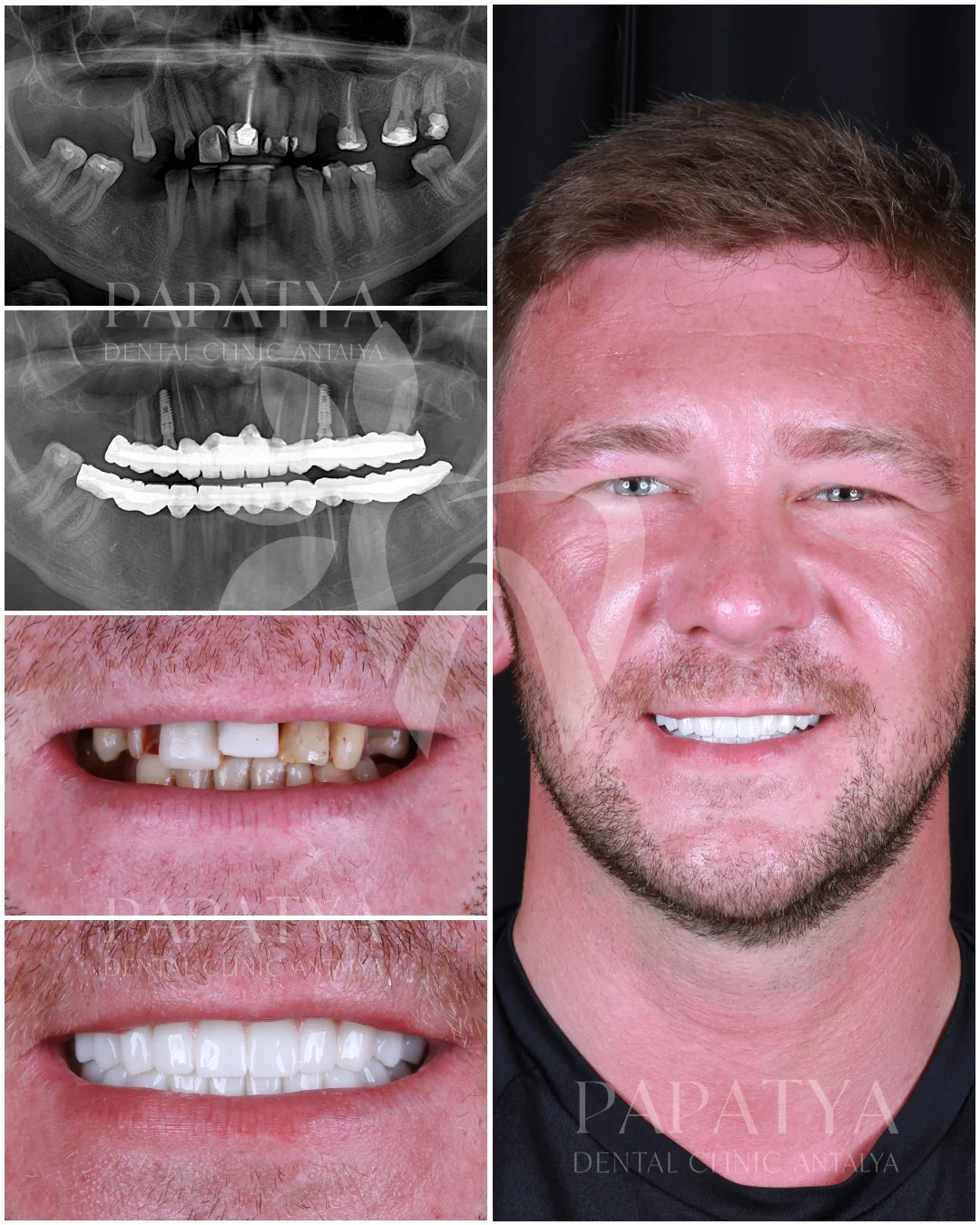
Start
24 June 2025
End
27 June 2025
How Long Do Crowns Last? Frequently Asked Questions
How long do dental crowns last?
Most crowns last more than ten years. In one specialist practice that followed 2,340 metal-ceramic crowns for up to 25 years, an estimated 97% of crowns on teeth with a good outlook were still in place at ten years and 85% at 25 years. Zirconia and E-max crowns have a shorter record, but in a 2026 meta-analysis their five-year survival, between 96.8% and 98.5%, was similar to the 97.1% for metal-ceramic crowns.
Do crowns last as long on back teeth as on front teeth?
Zirconia and E-max crowns do: in a 2026 meta-analysis of 64 studies, they performed similarly on front and back teeth. Metal-ceramic and feldspathic porcelain crowns were the exceptions in that analysis, although a 25-year study of 2,340 metal-ceramic crowns found no difference by tooth position. Back teeth take the most biting force, which is one reason zirconia is usually chosen for them.
How long do zirconia crowns last?
Over five years, zirconia crowns do about as well as metal-ceramic crowns, but few studies go further. In a 2026 meta-analysis, 96.8% of monolithic zirconia crowns and 97.3% of zirconia crowns with a porcelain layer were still in place after five years; a 2021 summary of earlier reviews reported 91.2% to 95.9% for zirconia crowns on natural teeth. Most studies of monolithic zirconia do not yet go beyond five years.
How long do E-max crowns last?
E-max crowns can last more than 15 years: in one private practice, an estimated 96.5% of 2,392 E-max restorations on back teeth, most of them full crowns, were still in place after 16.9 years. Monolithic E-max crowns also had the highest five-year survival in a 2026 meta-analysis of 64 studies, 98.5%.
Do crowns from Turkey last as long as crowns made in the UK or the US?
They can, because how long a crown lasts depends on the health of the tooth, the fit of the edge, the material and how the crown is looked after, not on the country. Before you book, ask why each tooth needs a crown, which material is used and who makes the crowns. At Papatya Dental Clinic, crowns are designed and milled in the clinic's own laboratory in Antalya.
Are dental crowns permanent?
A crown is fixed in place and is not taken out, but it is wiser not to count on it lasting for life. Studies in single practices have followed crowns for 17–25 years and found most still in place at the end, and when a crown does fail, it can usually be replaced if the tooth underneath is still sound.
Why do crowns fail?
Most crowns that fail after many years do so because of the tooth or the gum underneath: decay at the edge, gum disease or a problem with the nerve or root. In a 25-year study of 2,340 metal-ceramic crowns, 101 of 133 failures were of this kind, and only 4 crowns were replaced because the porcelain broke.
Do crowns on root-treated teeth last as long?
Not quite. In a 2024 review of 26 studies, crowns on living teeth had the highest five-year survival, 98.3%, while crowns on root-treated teeth ranged from 85.7% to 95.0% depending on the post and the material. A crown still protects a root-treated tooth: in a study at the University of Iowa, root-treated teeth left without a crown were lost six times as often as crowned ones.
How long do crowns on implants last?
In a study of 652 crowns on implants followed for up to 12.8 years, 96% were still in place after five years and 92% after ten. Chipping was the most common problem; it happened less often with monolithic zirconia than with fully layered crowns, although zirconia and E-max crowns overall failed more often than metal-ceramic ones in that study.
Can a crown last 20 years?
Yes, many do. In a 25-year study of 2,340 metal-ceramic crowns in one specialist practice, an estimated 85% of crowns on teeth with a good outlook were still in place at 25 years. Cleaning around the edge, regular check-ups and a night guard if you grind help a crown last as long as possible.
Do crowns need to be replaced every ten years?
No. Crowns are not replaced on a schedule. They are replaced when they break, come loose, have decay underneath or no longer look right.
Can a chipped crown be repaired?
A small chip can sometimes be polished or repaired with composite. A larger chip or a crack usually means a new crown. Monolithic crowns chip less often than crowns with a porcelain layer.
What happens if a crown comes off when I am back home?
Keep the crown, avoid chewing on that side and send a photo to your coordinator on WhatsApp. Papatya Dental Clinic follows up every treatment with 12 months of online aftercare. Depending on what has happened, you are advised by your dentist in Antalya, referred to a partner aftercare dentist where one is available or invited back to the clinic.
Can I meet the team before I travel?
Yes. Papatya Dental Clinic has offices in London (25 Southampton Buildings) and Helsinki, where you can have a consultation and plan your treatment; all treatment is carried out in Antalya. The clinic also holds MeetUp events in cities in the UK and the US where you can meet the team in person. If you would rather start from home, send photos and any recent X-rays for an online assessment.
How many days do I need in Antalya for crowns?
Crowns usually take 3–5 days, in two appointments: the teeth are prepared at the first and the crowns are fitted at the second. If root canal or gum treatment is needed first, plan for a longer stay.
Medical sources
View medical sources
Medically reviewed by

Muhammet Buğra Şener
Dentist, Aesthetic Dentistry
View doctor profile
Şerife Nur Kerpiçci
Dentist, Aesthetic Dentistry
View doctor profile
Nilufar Tulanova Şener
Dentist, Aesthetic Dentistry
View doctor profileLast medical review: 27 October 2026