

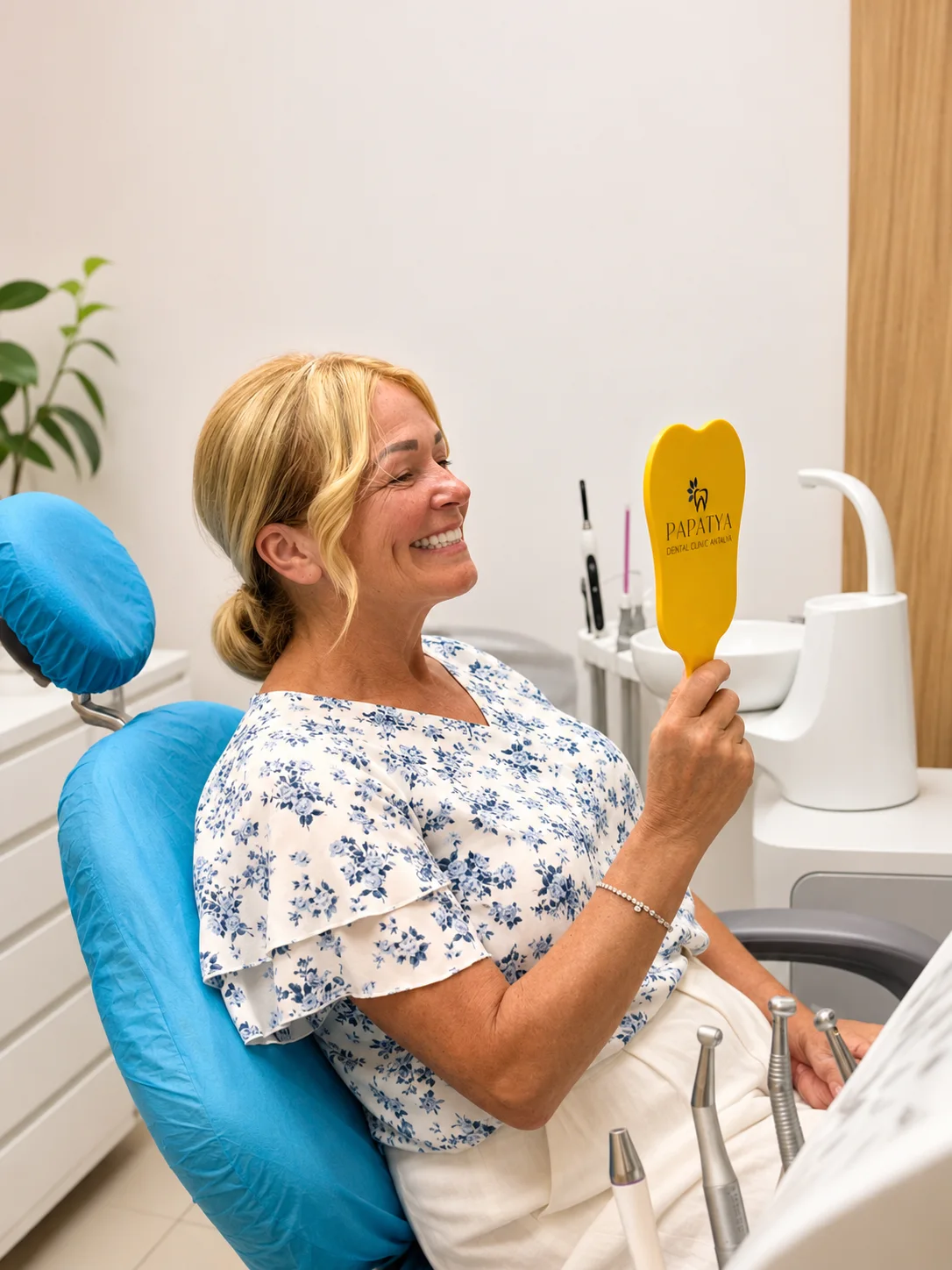
What treatment in Antalya involves for a Bristol patient
Travelling from Bristol to Antalya for dental care means fitting a course of treatment into one or two planned trips instead of spreading it over months of local appointments. That changes how the work is sequenced, how much rest you need between visits, and how your follow-up is arranged.
Most people who look into this are dealing with something that has built up over time: missing teeth, old crowns that keep failing, or a plan quoted at home that they have put off. The question is rarely only about the procedure. It is about whether a fixed set of dates can hold a treatment plan safely.
Antalya has a large concentration of private dental clinics and a direct flight network from the UK, which is why it appears so often in searches from Bristol. Papatya Dental works with international patients on this basis, planning the clinical steps around arrival and departure dates rather than around weekly visits.
This page is a guide, not a treatment plan. What you actually need depends on an examination and current radiographs. Use it to understand the shape of the process, the realistic risks, and the questions worth asking before you commit to dates.
Flights from the South West
There is no year-round direct Bristol to Antalya service you can rely on for medical dates. Many patients fly seasonally direct in summer, or connect through London, Istanbul or another hub. Check the route before you book clinical dates.
Two trips are common
Implant work usually needs a first visit for surgery and a second visit months later for the final teeth. Crowns, veneers and root canal work can often be completed within a single stay.
Records travel with you
Recent radiographs, a list of your medicines and any specialist letters let the clinic plan before you land. Your Bristol dentist or GP can usually supply these on request.
Your home dentist still matters
Routine checks, hygiene appointments and emergency care after you return happen in the UK. Tell your NHS or private practice what has been done and share the treatment records you are given.
Time in Antalya
A single stay for fixed work is typically several days to two weeks, because laboratory stages and fitting appointments are spaced across the visit rather than done in one sitting.
Who this route suits and who should think again
Treatment abroad is a scheduling decision as much as a clinical one. It works best when your general health is stable, your dental problem is well defined, and you can commit to the dates without pressure. Below are the situations that tend to go smoothly and the ones that need a rethink.
You have a clear, contained problem
Missing teeth in one area, a set of failing crowns, or worn front teeth can be planned accurately from records and completed within a defined number of appointments.
Your general health is stable
Controlled blood pressure, well managed diabetes and no recent cardiac or cancer treatment make surgery and travel far more predictable. Bring your repeat prescription list.
You can take the full block of time
Being able to stay for the whole planned period, including a spare day or two, matters more than finding the neatest flight. Rushed departures are where problems start.
You already have a dentist in Bristol
Ongoing local care makes aftercare straightforward. If something needs checking six weeks later, you have someone who knows your mouth and can look at it quickly.
Bone and gum condition
A CBCT scan or panoramic radiograph shows bone volume, sinus position and nerve location. This decides whether implants are possible directly or whether grafting is needed first, which adds months.
Bite and existing restorations
How your teeth meet, any grinding, and the state of old fillings and root treatments all affect what can be built on top. Ignoring the bite is a common reason new work fails early.
Active infection or untreated gum disease
Placing implants or new crowns over inflamed gums risks early failure. Gum treatment usually has to be completed and reassessed first, which may be better done at home before you travel.
Complex medical conditions needing close monitoring
Recent heart surgery, intravenous bisphosphonate therapy, uncontrolled diabetes or immunosuppression can all change surgical planning. These cases need a written opinion from your treating doctor before dates are agreed.
Risks worth taking seriously
Every dental procedure carries risk, and travel adds a layer of its own. None of these are reasons to avoid treatment abroad, but each one should have a named plan before you fly.
Something goes wrong after you get home
A crown debonds, a stitch loosens or a screw works free once you are back in Bristol. Agree in advance who you contact, how quickly the clinic replies, and what a UK dentist is allowed to do as a temporary fix without invalidating the work.
Treatment compressed into too few days
Healing and laboratory stages have their own timescales. When a plan is squeezed to fit a short flight window, checks get skipped. Ask for the schedule day by day and make sure it has slack in it.
Implant failure or delayed healing
Implants can fail to integrate, most often with smoking, poorly controlled diabetes or gum infection. This is uncommon but real, and the plan should state what happens, clinically and practically, if it occurs.
Nerve and sinus complications
Lower jaw implants sit near the nerve that supplies the lip and chin; upper back implants sit near the sinus. Three dimensional imaging and guided placement reduce this risk but do not remove it. Numbness that persists must be reported at once.
Flying and recent surgery
Swelling, bleeding and pain are usually worse in the first days. Long journeys also carry a clot risk after any surgery. Ask when it is safe to fly, move around during the flight, and follow the advice you are given rather than the ticket you booked.
Records that do not follow you
Without written details of implant brand, sizes, materials and any medicines given, a UK dentist is working blind years later. Insist on a full written record and radiographs before you leave the clinic.
How the process runs, step by step
The sequence below is typical for a patient travelling from Bristol. Simple work compresses it; implant cases stretch it across two visits several months apart.
- 1
Remote assessment
You send photographs and any recent radiographs. The clinic reviews them, asks about your medical history and medicines, and sets out what looks possible and what still needs checking in person.
- 2
Planning the dates
Once the likely plan is agreed, the number of days needed is fixed and you book travel around it. Leaving a buffer at the end of the trip protects you if a stage takes longer than expected.
- 3
Examination on arrival
The first appointment repeats the assessment properly: clinical examination, current imaging, gum condition and bite. The plan is confirmed or revised at this point, before any treatment starts.
- 4
Preparation
Anything that has to happen first is done first. That may be hygiene treatment, removal of teeth that cannot be saved, or root canal work on teeth that will carry crowns.
- 5
Main treatment stage
Implants are placed, or teeth are prepared and impressions or digital scans taken. Temporary teeth are usually fitted so you are not left with gaps while you travel and heal.
- 6
Fitting and handover
Final restorations are tried in, adjusted and fitted, and the bite is checked. You leave with written records, radiographs, care instructions and a named contact for questions after you get home.
Other options to consider
Travelling is not the only route, and for some problems it is not the most sensible one. Weigh these before you book anything.
Staged treatment in the UK
Spreading work across local appointments avoids travel entirely and keeps aftercare in one place. It usually takes longer overall and depends on what your practice can offer and how quickly you can be seen.
A less extensive plan
Not every failing tooth needs replacing with an implant. Repairing what is there, or replacing fewer units, is sometimes enough to restore comfort and function. Ask what the minimum reasonable plan looks like.
Removable or partial solutions
A well made denture or partial denture restores chewing and appearance without surgery. It suits people who cannot have implants for medical reasons or who want to delay a bigger decision.
Stabilise now, decide later
Treating gum disease, settling infection and getting the mouth healthy is a genuine first step in its own right. Restorative choices are better and more predictable once that is done.
Methods and technology that make the trip workable
The reason a course of treatment can be delivered in a defined number of days is largely digital. Scanning, planning and manufacturing that once took weeks of posting models back and forth now happen in the same building.
This matters more for an overseas patient than a local one. Every stage that can be planned before you land, or completed on site the same day, is a stage that does not force you to extend your stay or come back.
None of it replaces clinical judgement. Technology narrows the margin for error and shortens the timeline; the examination and the treatment plan still decide the outcome.
Three dimensional imaging
CBCT scanning shows bone height, width and the position of nerves and sinuses. Implant positions are planned on the scan before any surgery is carried out.
Guided implant placement
A surgical guide made from the scan transfers the planned position to the mouth. This improves accuracy and often allows smaller incisions and less swelling.
Digital impressions
An intraoral scanner records the teeth without impression material. Files go straight to the laboratory, removing a common source of delay and remakes.
On site laboratory
Having technicians in the same building means try ins and adjustments can be turned around within the visit rather than posted away and waited on.
Shared planning before you fly
Records and images can be reviewed and discussed while you are still in Bristol, so the first appointment confirms a plan rather than starting one from scratch.
Recovery, aftercare and staying in touch
What happens after treatment decides how well it lasts. The timeline below is typical for surgical work; crowns and veneers settle much faster.
- 1
First 48 hours
Swelling, bruising and discomfort peak. Cold packs, prescribed pain relief and soft food help. Avoid rinsing hard, smoking and alcohol, all of which disturb healing.
- 2
First week
Swelling settles and eating becomes easier. Any stitches are checked or removed before you travel where possible. Keep the area clean but gentle.
- 3
Weeks two to six
Normal function returns. New crowns or temporary teeth are being tested by everyday eating, which is when a high spot or a sore area shows up and needs adjusting.
- 4
Three to six months
Implants integrate with bone over this period before final teeth are attached. This is the gap between visits, and it is not a stage that can be shortened by wishing.
Daily cleaning around new work
Implants and bridges need interdental brushes or floss designed for the purpose. Plaque left at the gum margin is the main cause of late failure, not the implant itself.
Regular reviews at home
Book a check with your Bristol dentist after you return and keep to a recall interval agreed with them. Ask for the new work and gum condition to be assessed at each visit.
Signs of infection or bleeding that will not settle
Increasing pain after the third day, swelling that spreads, fever, a bad taste or bleeding that does not stop with pressure all need to be reported the same day.
Numbness, looseness or a change in your bite
Persistent numbness of the lip or chin, a restoration that feels loose, or teeth that suddenly meet unevenly should never be left to see if they settle.
What shapes the scope and the timescale
Rather than a figure, what is useful before you commit is knowing what makes a plan bigger or longer. These are the factors that most often change the scope after the first examination.
Number and position of teeth involved
Front teeth carry appearance demands that back teeth do not, and a full arch is a different undertaking from two units. The count and the location both change the number of appointments.
Whether preparatory treatment is needed
Gum treatment, extractions, root canal work or bone grafting have to happen before restorative work. Each adds appointments, and grafting adds months of healing.
Materials and construction
Zirconia, layered ceramic and metal ceramic behave differently and take different laboratory time. The choice is clinical as much as anything, based on your bite and where the tooth sits.
One visit or two
Work that can be completed in a single stay has a different shape to implant treatment split across two trips. This drives your travel planning more than any other factor.
How well the mouth is maintained afterwards
Cleaning habits, smoking and keeping up regular reviews determine whether the plan stays as delivered or needs revisiting. Maintenance is part of the scope, not an optional extra.
Before / After

Common questions from patients in Bristol
Can I fly direct from Bristol to Antalya?
Direct flights from Bristol run seasonally rather than all year, so availability depends on when your treatment falls. Many patients connect through London or Istanbul instead. Confirm the route and timings before you fix clinical dates, because a missed connection matters far more when an appointment is waiting at the other end.
How long do I need to stay?
Crowns, veneers and root canal work usually fit into a stay of roughly one to two weeks, because laboratory stages are spread across the visit. Implant treatment normally needs two trips: a shorter first visit for surgery, then a second visit after healing to fit the final teeth. Your plan should state the days needed before you book flights.
What happens if there is a problem when I am back in the UK?
Agree the arrangement before you travel. You should have a named contact at the clinic, a stated response time, and written records that let a Bristol dentist understand what was done. Minor issues such as a debonded crown or a rough edge can often be dealt with locally, while anything involving the implant itself usually needs the treating clinic's input.
Will my NHS dentist keep seeing me?
Routine NHS care, checks and hygiene appointments continue as normal, and having work done privately abroad does not remove you from a practice list. Tell them what has been done and share the records. NHS practices are not obliged to repair or replace private work carried out elsewhere, so ask yours what they will and will not take on.
Is dental care in Turkey regulated?
Yes. Dentists in Turkey are trained through university dental faculties and clinics are licensed and inspected by the Ministry of Health. The regulator is not the General Dental Council, so UK complaint routes do not apply. Ask which practitioners will treat you, check their registration, and get the plan in writing.
Should I take out insurance?
Standard travel insurance usually excludes planned medical treatment abroad and anything arising from it. Read the policy wording rather than the summary, ask specifically about complications from elective dental work, and consider a policy designed for medical travel. Also check what cover exists for a delayed return if healing takes longer.
What records should I bring, and what should I leave with?
Bring recent radiographs, a list of medicines and doses, and any letters about heart conditions, diabetes, bisphosphonate use or immunosuppression. Leave with a written treatment record, post treatment radiographs, details of implant brand and sizes, materials used and any prescriptions. Those documents are what make care possible years later.
How do I judge a clinic from a distance?
Look at how they answer questions rather than how quickly they promise a result. A clinic planning properly will ask for your medical history, want current imaging, explain what could change after examination, and set out the schedule day by day. Vague timelines and plans agreed without records are the warning signs.